A 2024 Consumer Product Safety Commission report revealed that 37% of inversion table injuries stemmed from equipment failure rather than user error. This statistic exposes a critical gap in consumer awareness: most buyers focus on features and price while overlooking the certifications that determine whether their inversion table meets basic safety standards. Understanding inversion table regulations and standards—and knowing what certifications actually matter for safety and quality—separates reliable equipment from potential hazards.
Buying an inversion table without verifying certifications resembles purchasing a car without checking crash test ratings. The frame might look sturdy, the padding might feel comfortable, but without third-party validation, you’re trusting manufacturer claims alone. This guide decodes the regulatory landscape, identifies which certifications protect your safety, and reveals what quality standards separate professional-grade equipment from basement bargains.
Key Takeaways
- ASTM F3096 certification represents the gold standard for inversion table structural safety and performance testing
- UL or ETL electrical certification becomes mandatory for models with heat, massage, or motorized features
- ISO 9001 quality management certification indicates consistent manufacturing standards but doesn’t guarantee product safety
- FDA registration confirms manufacturer compliance with medical device reporting requirements without validating effectiveness
- Weight capacity certifications require third-party testing verification, not just manufacturer specifications
Understanding the Regulatory Landscape for Inversion Tables
The inversion table industry operates within a complex regulatory framework that varies by country, product classification, and intended use. Manufacturers navigate multiple oversight bodies, each with distinct requirements and enforcement mechanisms.
FDA Classification and Medical Device Status
The Food and Drug Administration classifies inversion tables as Class I medical devices under 21 CFR 890.5975. This classification places them in the lowest-risk category, requiring manufacturers to register their facilities and list their products but exempting them from premarket approval. The FDA mandates Good Manufacturing Practices (GMP) compliance and adverse event reporting through the Medical Device Reporting (MDR) system.
FDA registration numbers appear on many inversion tables, but this designation confirms administrative compliance rather than safety testing. The agency doesn’t evaluate individual products before market entry. Instead, manufacturers self-certify their compliance with general controls, including proper labeling, manufacturing standards, and post-market surveillance.
Class I status means inversion tables face less scrutiny than implantable devices or diagnostic equipment. The FDA can issue warning letters, mandate recalls, or pursue enforcement actions when products cause injuries, but proactive testing doesn’t occur. This regulatory approach places significant responsibility on manufacturers to implement quality controls and on consumers to verify third-party certifications.
Consumer Product Safety Commission Oversight
The CPSC monitors inversion tables under its broad mandate to protect consumers from unreasonable injury risks. The agency tracks injury reports through the National Electronic Injury Surveillance System (NEISS), which captures emergency department visits related to product use.
Between 2019 and 2023, NEISS data recorded approximately 2,400 inversion table-related injuries annually. The CPSC investigates patterns suggesting design defects, manufacturing flaws, or inadequate warnings. When hazards emerge, the agency coordinates voluntary recalls with manufacturers or mandates corrective actions.
The CPSC doesn’t establish specific performance standards for inversion tables but enforces general safety requirements under the Consumer Product Safety Act. Manufacturers must report incidents involving death, serious injury, or product defects within 24 hours. The agency’s enforcement actions typically target structural failures, ankle restraint malfunctions, and inadequate warning labels.
Understanding these regulatory frameworks helps consumers recognize what government oversight does and doesn’t provide. Inversion table safety extends beyond regulatory compliance to include third-party certifications that validate actual performance.
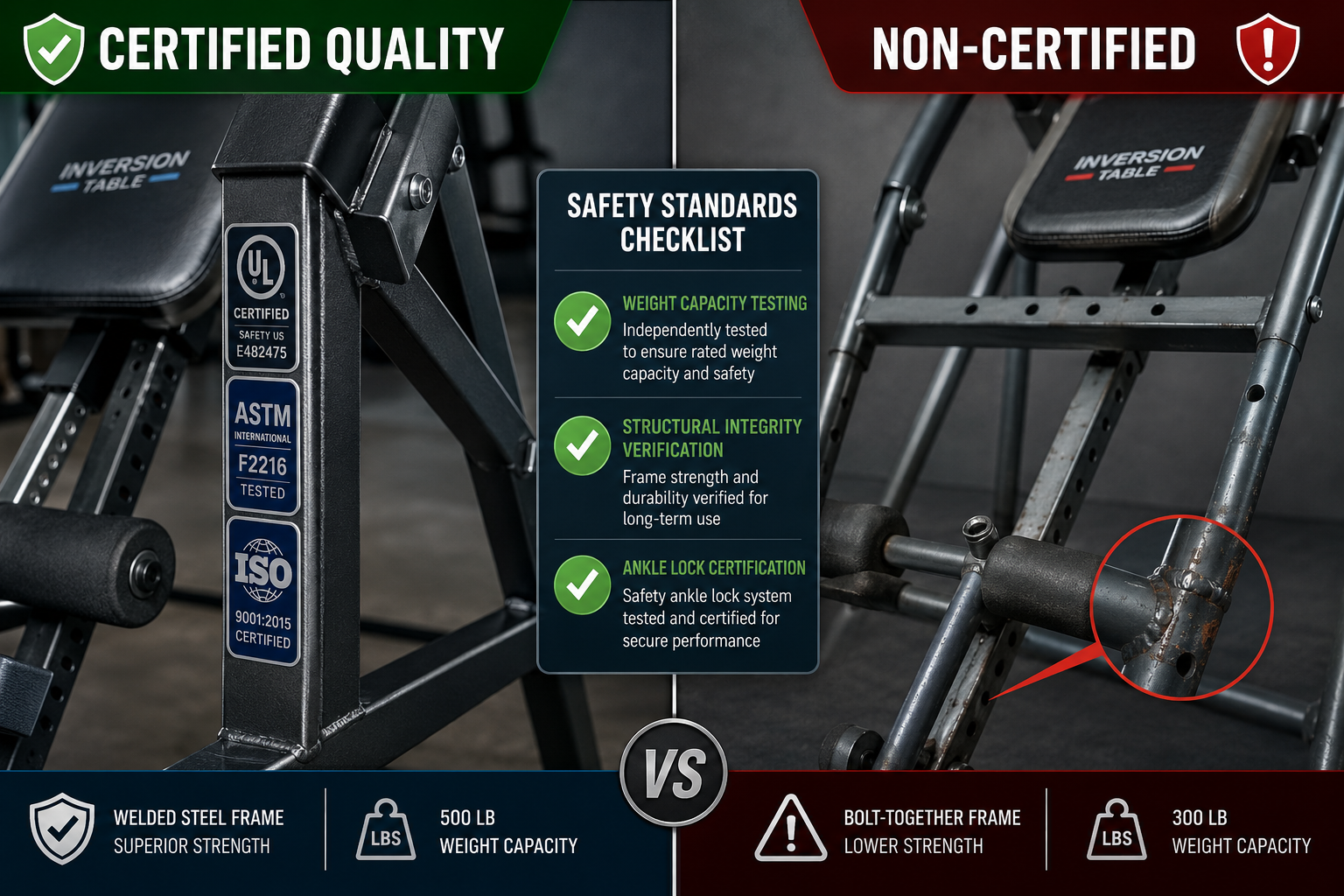
Critical Safety Certifications That Actually Protect Users
Third-party certifications provide independent verification that inversion tables meet specific safety and performance standards. These certifications require testing by accredited laboratories and periodic factory inspections to maintain validity.
ASTM F3096: The Gold Standard for Structural Safety
The American Society for Testing and Materials developed ASTM F3096 specifically for inversion tables in 2017. This standard establishes comprehensive requirements for structural integrity, stability, ankle restraint systems, and user safety features.
ASTM F3096 testing includes:
- Static load testing: Frames must support 1.5 times the rated weight capacity without permanent deformation
- Dynamic load testing: Equipment must withstand 10,000 cycles of inversion and return without structural failure
- Ankle restraint strength: Locking mechanisms must secure users at maximum weight capacity during full inversion
- Stability requirements: Tables must resist tipping during normal use and emergency dismount scenarios
- Sharp edge and pinch point evaluation: All user contact surfaces must meet safety thresholds
Products bearing ASTM F3096 certification underwent testing at independent laboratories like Intertek, SGS, or Bureau Veritas. These facilities verify compliance through destructive testing, meaning manufacturers submit multiple units that testers push to failure. The certification validates that production models match tested prototypes.
ASTM F3096 compliance costs manufacturers between $15,000 and $35,000 for initial testing and certification. This investment explains why budget models under $150 rarely carry this certification. The standard requires annual surveillance testing to maintain certification validity, ensuring ongoing quality control.
UL and ETL Electrical Safety Certifications
Inversion tables with electrical components—heat therapy, massage motors, or motorized inversion—require electrical safety certification. Underwriters Laboratories (UL) and Intertek’s ETL mark represent the two primary certifications for electrical safety in North America.
UL 1647 covers electrically heated bedding and similar products, applying to inversion tables with heating elements. The standard evaluates:
- Electrical insulation and grounding
- Temperature control accuracy and limits
- Fire resistance of materials
- Protection against electrical shock
- Electromagnetic interference
ETL certification provides equivalent validation through Intertek’s testing protocols. Both certifications require factory inspections every quarter to verify continued compliance. Manufacturers display the UL or ETL mark prominently on certified products, typically near the power cord or control panel.
Products lacking electrical certification pose serious risks. Inadequate insulation can cause electrical shock, especially when users perspire during inversion. Faulty heating elements may exceed safe temperature limits, causing burns or igniting padding materials. The assembly process should include verification of electrical certifications before first use.
ISO 9001 Quality Management Certification
ISO 9001 certification validates that manufacturers implement systematic quality management processes. This international standard doesn’t test individual products but audits the systems manufacturers use to ensure consistent quality.
ISO 9001 requirements include:
- Documented quality policies and procedures
- Regular internal audits of manufacturing processes
- Corrective action systems for defects
- Supplier quality management
- Customer feedback integration
- Continuous improvement protocols
Manufacturers display ISO 9001 certification in marketing materials and on product packaging. The certification requires annual surveillance audits by registrars like BSI, DNV, or TÜV. These audits verify that quality systems remain active and effective.
ISO 9001 certification indicates organizational commitment to quality but doesn’t guarantee product safety. A manufacturer can maintain ISO 9001 certification while producing substandard products if their quality system consistently produces those results. Consumers should view ISO 9001 as a positive indicator that complements rather than replaces product-specific safety certifications.
CE Marking for European Markets
The CE mark indicates conformity with European Union safety, health, and environmental protection standards. Inversion tables sold in EU markets must carry CE marking to demonstrate compliance with the Medical Devices Directive (93/42/EEC) or the newer Medical Devices Regulation (2017/745).
CE marking requires manufacturers to:
- Conduct risk analysis and clinical evaluation
- Implement quality management systems
- Prepare technical documentation
- Affix CE marking and issue Declaration of Conformity
- Appoint an authorized representative in the EU
Unlike UL or ASTM certifications, CE marking allows manufacturer self-declaration for Class I medical devices. Manufacturers assess their own compliance without mandatory third-party testing. This self-certification approach makes CE marking less rigorous than North American certifications, though manufacturers remain legally liable for compliance.
Notified Body involvement becomes mandatory for higher-risk medical devices but remains optional for basic inversion tables. Products displaying a four-digit number after the CE mark underwent third-party assessment, providing greater assurance than self-certified CE marks.
Quality Standards Beyond Basic Safety Compliance
Safety certifications establish minimum thresholds, but quality standards determine long-term durability, user comfort, and performance consistency. These standards separate equipment that meets basic requirements from products that deliver reliable results over years of use.
Weight Capacity Testing and Verification
Manufacturers advertise weight capacities ranging from 250 to 600 pounds, but these claims require verification through standardized testing. ASTM F3096 mandates that frames support 1.5 times the rated capacity, but manufacturers sometimes inflate ratings without proper testing.
Third-party verification involves:
- Static load testing: Applying maximum rated weight plus 50% for 60 seconds without permanent deformation
- Fatigue testing: Cycling between zero and maximum load 10,000 times to simulate years of use
- Ankle restraint load testing: Verifying that locking mechanisms secure maximum weight during full inversion
- Frame deflection measurement: Ensuring structural flex remains within safe limits under load
Quality manufacturers provide test reports documenting actual performance rather than theoretical calculations. These reports specify the testing laboratory, date, and methodology. Consumers should request verification documentation before purchasing tables claiming capacities above 300 pounds.
Budget models often use thinner gauge steel and fewer welds, reducing actual weight capacity below advertised ratings. Frame failure typically occurs at weld points or pivot mechanisms rather than main tubes. Premium versus budget comparisons reveal that construction quality directly correlates with long-term reliability.
Ankle Restraint System Standards
Ankle restraint failures represent the most dangerous inversion table defect. Users inverted at 60-90 degrees depend entirely on ankle locks to prevent falls. Quality standards for restraint systems exceed basic safety requirements.
Premium ankle restraint systems feature:
- Ratcheting mechanisms: Multiple locking positions with audible clicks confirming engagement
- Redundant safety features: Secondary locks or pins preventing accidental release
- Padded comfort: High-density foam reducing pressure points during extended sessions
- Tool-free adjustment: Quick-release systems allowing rapid customization without compromising security
- Corrosion-resistant materials: Stainless steel or coated components maintaining function despite perspiration exposure
Testing protocols should verify that ankle restraints maintain security during dynamic movements. Users shift position, perform stretches, and occasionally make sudden movements during inversion. Restraint systems must accommodate these forces without loosening or releasing.
Quality manufacturers test ankle restraints separately from frame testing, applying forces that simulate emergency scenarios. These tests include sudden weight shifts, rotational forces, and sustained maximum load conditions. Documentation should specify the testing methodology and pass/fail criteria.
Frame Construction and Welding Quality
Frame construction determines structural integrity and longevity. Quality standards address steel gauge, welding techniques, and finish quality.
Steel gauge specifications: Premium frames use 11-14 gauge steel for main tubes, providing superior strength-to-weight ratios. Budget models often use 16-18 gauge steel, reducing material costs but compromising durability. Thicker gauge steel resists flexing under load and maintains structural integrity through thousands of inversion cycles.
Welding quality indicators: Professional welding creates smooth, consistent beads without gaps, porosity, or incomplete penetration. Quality manufacturers use MIG or TIG welding processes with certified welders. Visual inspection reveals welding quality—uniform beads indicate proper technique while irregular, spattered welds suggest rushed production.
Powder coating and finish: Quality frames receive powder coating after sandblasting, creating durable, chip-resistant finishes. This process involves electrostatically applying dry powder then curing at high temperatures. Inferior finishes use spray paint, which chips easily and exposes steel to corrosion.
Joint reinforcement: Stress points require gussets, reinforcement plates, or double-wall construction. Quality manufacturers identify high-stress areas through finite element analysis and add reinforcement before production. Budget models often lack reinforcement, leading to premature failure at pivot points and adjustment mechanisms.
Bearing and Pivot Quality Standards
Smooth, controlled rotation depends on bearing quality and pivot design. These components endure significant forces during inversion and return cycles.
Quality pivot systems incorporate:
- Sealed bearings: Protection from dust and moisture extending service life
- Precision machining: Tight tolerances reducing play and wobble
- Lubrication systems: Factory-applied lubricants maintaining smooth operation
- Hardened steel components: Wear-resistant materials preventing premature degradation
Premium manufacturers specify bearing ratings and replacement intervals. These specifications indicate engineering rigor and commitment to long-term performance. Budget models often use bushings instead of bearings, creating friction that increases over time and makes inversion progressively more difficult.
Testing protocols should verify that pivot systems maintain smooth operation through 10,000 cycles without binding, excessive noise, or increased resistance. Quality manufacturers conduct accelerated life testing, simulating years of use in compressed timeframes.
What Certifications Actually Matter: A Practical Hierarchy
Not all certifications carry equal weight for consumer safety and product quality. This hierarchy ranks certifications by their practical impact on user protection and equipment performance.
Tier 1: Essential Safety Certifications
ASTM F3096 compliance stands as the single most important certification for inversion tables. This standard directly addresses the specific hazards associated with inversion equipment through comprehensive testing protocols. Products lacking ASTM F3096 certification require exceptional scrutiny of alternative safety documentation.
UL or ETL electrical certification becomes mandatory for any model with electrical components. The risks of electrical shock, burns, or fire make this certification non-negotiable for heated or motorized tables. Models without electrical features don’t require this certification.
Tier 2: Quality Assurance Indicators
ISO 9001 certification signals systematic quality management but doesn’t replace product-specific testing. This certification provides confidence in manufacturing consistency and defect management systems. Manufacturers with ISO 9001 certification typically demonstrate greater organizational maturity than uncertified competitors.
Weight capacity verification through third-party testing validates manufacturer claims. Independent laboratory reports provide objective evidence that frames perform as advertised. This verification becomes critical for users near or above 250 pounds.
Tier 3: Supplementary Certifications
CE marking indicates European market compliance but offers limited value for North American consumers. The self-certification approach reduces its reliability compared to third-party verified standards. CE marking provides minimal assurance unless accompanied by Notified Body numbers.
FDA registration confirms administrative compliance without validating safety or effectiveness. While legitimate manufacturers maintain FDA registration, this designation alone doesn’t distinguish quality products from inferior alternatives.
Red Flags: Missing or Questionable Certifications
Several warning signs indicate inadequate safety validation:
- Vague certification claims: Phrases like “meets safety standards” without specifying which standards or providing documentation
- Expired certifications: Dates older than three years suggesting manufacturers discontinued surveillance testing
- Unverifiable certification bodies: Organizations without accreditation from recognized authorities
- Missing electrical certification: Models with heating or massage features lacking UL or ETL marks
- Refusal to provide documentation: Manufacturers unable or unwilling to supply certification reports
The market growth in inversion tables has attracted manufacturers with varying commitment to safety standards. Consumers must verify certifications rather than accepting marketing claims at face value.
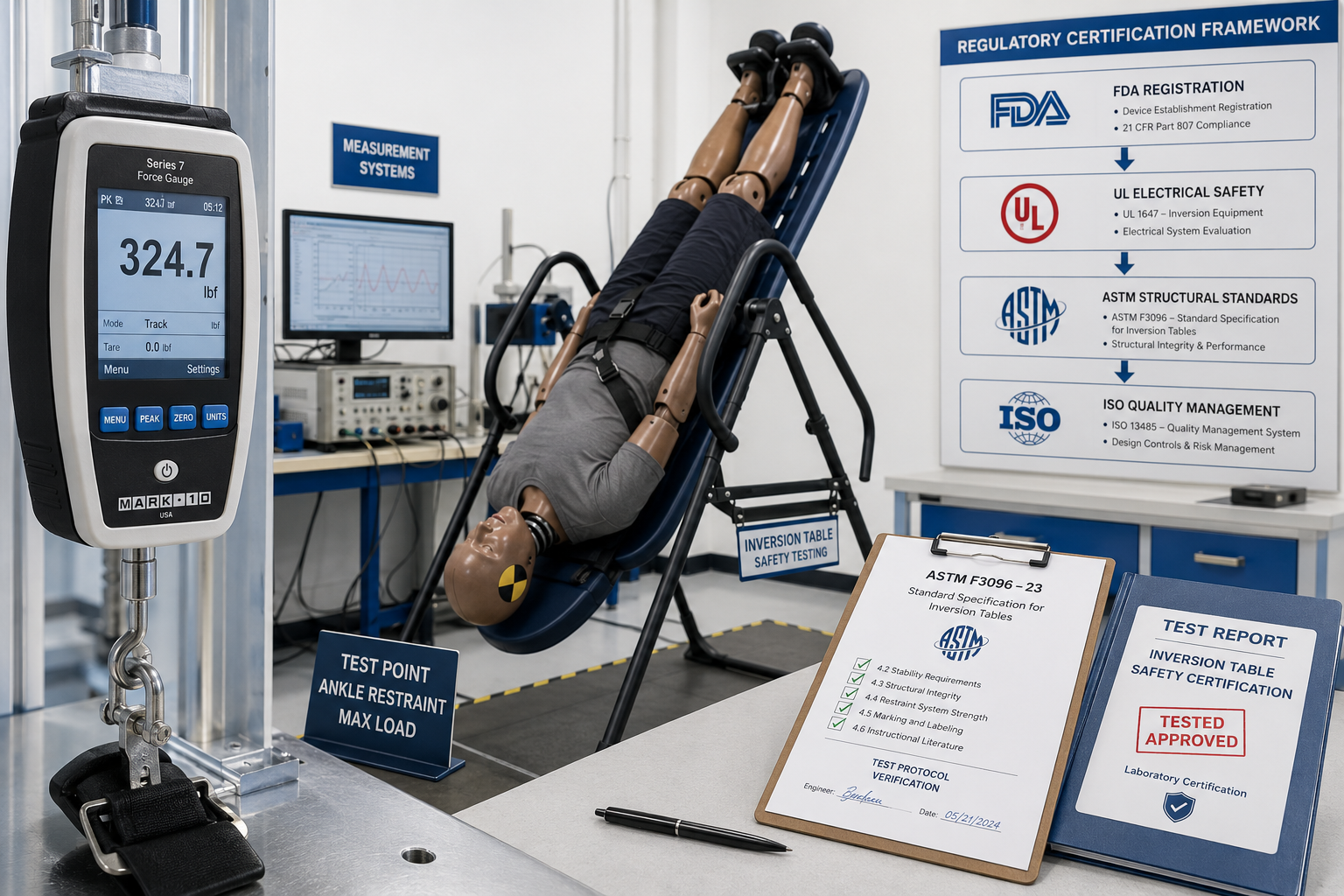
How to Verify Certifications Before Purchase
Certification marks appear on products, packaging, and marketing materials, but verification requires additional steps to confirm authenticity and current validity.
Checking ASTM Certification Status
ASTM International maintains a directory of certified products, though access requires membership. Consumers can verify ASTM F3096 compliance by:
- Requesting certification documentation: Legitimate manufacturers provide test reports showing compliance with specific ASTM requirements
- Identifying the testing laboratory: Accredited facilities like Intertek, SGS, or Bureau Veritas conduct valid testing
- Verifying certification dates: Recent testing (within three years) indicates active compliance
- Examining product labels: ASTM F3096 marks should appear on the frame or in user manuals
Manufacturers sometimes claim “ASTM compliance” without formal certification. True certification requires testing by accredited laboratories and periodic surveillance. Documentation should specify the testing facility, date, and specific test results.
Validating UL and ETL Marks
UL and Intertek maintain online databases allowing consumers to verify certification status:
- UL Product iQ database: Search by manufacturer name, model number, or UL file number at productiq.ul.com
- Intertek Directory: Verify ETL certifications through Intertek’s online directory
- Holographic labels: Genuine UL and ETL marks include security features preventing counterfeiting
- Complete marking requirements: Valid marks include the certification body logo, product category, and file number
Counterfeit certification marks appear on imported products, particularly those sold through online marketplaces. Verification through official databases confirms authenticity. Products lacking database entries despite displaying certification marks warrant extreme caution.
Confirming ISO 9001 Registration
ISO certification registrars maintain directories of certified organizations:
- IAF CertSearch: The International Accreditation Forum provides a global database of ISO certifications
- Registrar websites: Organizations like BSI, DNV, and TÜV list their certified clients
- Certificate validity: ISO 9001 certificates expire after three years, requiring recertification
- Scope verification: Certificates specify which facilities and processes the certification covers
ISO 9001 certification applies to manufacturing facilities rather than individual products. Verify that the certificate covers the specific factory producing your inversion table. Some manufacturers hold ISO 9001 certification for one facility while producing products at uncertified locations.
Requesting Documentation from Manufacturers
Reputable manufacturers provide certification documentation upon request. Contact customer service and request:
- Complete test reports for ASTM F3096 compliance
- UL or ETL certification numbers and scope
- ISO 9001 certificates with current validity dates
- Weight capacity testing documentation
- Warranty terms and conditions
Manufacturers refusing to provide documentation or offering vague responses raise serious concerns. Quality manufacturers maintain organized certification files and readily share this information with potential customers. The price differences between budget and premium models often reflect certification costs and quality assurance investments.
International Standards and Regional Variations
Inversion table regulations vary significantly across global markets, creating complexity for manufacturers and consumers purchasing imported products.
North American Standards (US and Canada)
The United States and Canada maintain similar regulatory frameworks with minor variations. Canadian Standards Association (CSA) certification provides equivalent validation to UL certification for electrical safety. Health Canada classifies inversion tables as Class I medical devices, mirroring FDA classification.
Key North American standards include:
- ASTM F3096 for structural safety and performance
- UL 1647 or CSA C22.2 for electrical safety
- FDA registration and GMP compliance
- CPSC general safety requirements
Products marketed in both countries typically pursue dual certification, displaying both UL and CSA marks on electrical components. The regulatory alignment between US and Canadian authorities simplifies compliance for manufacturers serving North American markets.
European Union Requirements
EU regulations emphasize conformity assessment and manufacturer responsibility. The Medical Devices Regulation (MDR 2017/745) replaced earlier directives in 2021, increasing documentation requirements and post-market surveillance obligations.
European standards include:
- EN 1970 for furniture safety (applicable to inversion tables)
- IEC 60601 for medical electrical equipment
- CE marking under MDR 2017/745
- REACH compliance for chemical substances
The EU system relies more heavily on manufacturer self-declaration than North American third-party certification. This approach reduces compliance costs but places greater legal liability on manufacturers. Products causing injuries expose manufacturers to strict liability under EU consumer protection laws.
Asia-Pacific Market Standards
Asian markets maintain diverse regulatory frameworks reflecting different development stages and consumer protection priorities.
Japan: Pharmaceutical and Medical Devices Agency (PMDA) classifies inversion tables as controlled medical devices requiring registration and quality management system compliance.
Australia: Therapeutic Goods Administration (TGA) regulates inversion tables as Class I medical devices with requirements similar to FDA standards.
China: National Medical Products Administration (NMPA) requires registration for medical devices sold domestically, though enforcement varies by region.
India: Central Drugs Standard Control Organization (CDSCO) oversees medical device regulation with evolving standards.
Manufacturers targeting global markets pursue multiple certifications, increasing costs but enabling broader distribution. Consumers purchasing imported products should verify that certifications match their local market requirements.
The Real Cost of Certifications and How It Affects Pricing
Certification expenses significantly impact retail pricing, explaining substantial cost differences between budget and premium models.
Certification Investment Breakdown
Manufacturers pursuing comprehensive certification face these approximate costs:
- ASTM F3096 testing and certification: $15,000-$35,000 initial, $5,000-$10,000 annual surveillance
- UL electrical certification: $8,000-$15,000 initial, $3,000-$6,000 annual
- ISO 9001 certification: $10,000-$25,000 initial, $5,000-$8,000 annual
- CE marking (with Notified Body): $5,000-$12,000
- Product liability insurance: $15,000-$50,000 annually
These costs total $50,000-$150,000 for initial certification plus $25,000-$75,000 in annual maintenance. Manufacturers amortize these expenses across production volumes, adding $30-$100 per unit depending on sales volume.
Budget manufacturers skip certifications to reduce costs, passing savings to consumers but eliminating independent safety validation. This cost reduction explains why budget models under $150 rarely carry comprehensive certifications.
Value Proposition of Certified Products
Certified products justify higher prices through:
- Reduced injury risk: Third-party validation confirms safety features function as designed
- Warranty protection: Manufacturers confident in their quality offer longer warranties
- Durability: Quality standards ensure products withstand years of regular use
- Resale value: Certified products maintain value better than uncertified alternatives
The price premium for certified products ranges from 40% to 150% compared to uncertified alternatives. This investment provides peace of mind and reduces the risk of equipment failure during use. Clinical outcomes depend partly on consistent, safe equipment performance.
When Budget Models Make Sense
Budget models without comprehensive certification suit specific use cases:
- Occasional use (less than twice weekly)
- Users well below maximum weight capacity
- Supplementary equipment for variety
- Trial periods before investing in premium models
Even budget purchases should verify basic safety features: stable base, secure ankle restraints, and smooth pivot action. Users should inspect welds, test locking mechanisms, and verify stability before inverting. Budget models require more frequent inspection and earlier replacement than certified alternatives.
Common Certification Myths and Misconceptions
Marketing claims and consumer misunderstandings create confusion about certification value and meaning.
Myth 1: FDA Approval Means Safety Testing
The FDA registers inversion table manufacturers but doesn’t approve individual products. Class I medical device status requires facility registration and adverse event reporting without premarket testing. “FDA registered” indicates administrative compliance, not safety validation.
Manufacturers sometimes imply FDA approval through ambiguous language. Phrases like “FDA registered facility” or “manufactured under FDA guidelines” describe minimum legal requirements rather than exceptional quality standards.
Myth 2: All Certifications Provide Equal Protection
Certification rigor varies dramatically. ASTM F3096 requires destructive testing by independent laboratories, while CE marking allows manufacturer self-declaration. ISO 9001 audits manufacturing processes without testing individual products. Understanding these differences helps consumers evaluate certification value.
Marketing materials often list multiple certifications without explaining their scope or significance. A product displaying FDA registration, CE marking, and ISO 9001 certification may lack the most important validation: ASTM F3096 structural testing.
Myth 3: Expensive Products Automatically Carry Better Certifications
Price correlates with certification investment but doesn’t guarantee it. Some premium-priced products emphasize features like heat and massage while skipping structural certifications. Consumers should verify specific certifications rather than assuming price reflects safety investment.
Conversely, some mid-priced products carry comprehensive certifications while allocating less budget to cosmetic features. Value-conscious consumers benefit from prioritizing safety certifications over premium padding or aesthetic details.
Myth 4: Certifications Guarantee Zero Risk
Certifications reduce risk but don’t eliminate it. Proper use remains essential—certified equipment can cause injury through misuse, excessive inversion angles, or ignoring medical contraindications. Certifications validate that equipment meets safety standards when used according to instructions.
Users must still follow protocols for gradual angle progression, session duration limits, and medical screening. Certified equipment provides a foundation for safe practice but doesn’t replace user responsibility.
Making Informed Purchasing Decisions Based on Certifications
Certification knowledge empowers consumers to evaluate products objectively and make safety-conscious purchasing decisions.
Pre-Purchase Certification Checklist
Before purchasing an inversion table, verify:
- ASTM F3096 certification: Request documentation showing third-party testing
- Electrical certification: Confirm UL or ETL marks for models with electrical features
- Weight capacity verification: Ensure your weight falls comfortably below maximum rating
- Manufacturer reputation: Research company history and customer service quality
- Warranty terms: Longer warranties indicate manufacturer confidence
- Return policy: Adequate trial periods allow in-home evaluation
This checklist prioritizes safety-critical certifications while considering practical factors affecting long-term satisfaction.
Questions to Ask Retailers and Manufacturers
Direct inquiries reveal manufacturer transparency and product quality:
- “Can you provide ASTM F3096 test reports for this model?”
- “Which laboratory conducted the certification testing?”
- “When was the most recent surveillance testing completed?”
- “Does the warranty cover structural failures and ankle restraint malfunctions?”
- “What is your process for handling safety complaints?”
Manufacturers providing detailed, confident responses demonstrate commitment to safety and quality. Vague answers or deflection suggest inadequate certification or quality control.
Evaluating Online Marketplace Purchases
Online marketplaces present unique challenges for certification verification. Third-party sellers may offer uncertified imports at attractive prices. Protect yourself by:
- Purchasing directly from manufacturer websites when possible
- Verifying seller authorization through manufacturer customer service
- Reading detailed reviews mentioning safety concerns or equipment failures
- Checking return policies before purchasing
- Inspecting products immediately upon delivery
Marketplace purchases often lack the customer support and warranty protection available through authorized dealers. The cost savings may not justify the increased risk, particularly for safety-critical equipment.
When to Consult Healthcare Providers
Medical professionals provide valuable guidance for individuals with specific health conditions. Consult your physician before purchasing if you have:
- Cardiovascular conditions including hypertension or atrial fibrillation
- Eye conditions including glaucoma or retinal issues
- Recent surgeries or injuries
- Pregnancy or potential pregnancy
- Osteoporosis or bone density concerns
Healthcare providers may recommend specific features or certifications based on your medical history. Their input helps match equipment capabilities to your therapeutic needs while minimizing risk.
Conclusion
Inversion table regulations and standards create a complex landscape where understanding what certifications actually matter for safety and quality protects consumers from equipment failures and injuries. ASTM F3096 certification stands as the gold standard, providing independent verification of structural integrity, ankle restraint security, and overall safety. UL or ETL electrical certification becomes non-negotiable for models with heating or motorized features, while ISO 9001 indicates quality management commitment without replacing product-specific testing.
The regulatory framework places significant responsibility on consumers to verify certifications rather than accepting manufacturer claims. FDA registration confirms administrative compliance without validating safety, while CE marking allows self-certification that provides minimal assurance. Third-party testing by accredited laboratories separates legitimate certifications from marketing language designed to imply safety without delivering it.
Price differences between budget and premium models often reflect certification investments and quality assurance systems. While budget options serve specific use cases, comprehensive certifications justify higher prices through reduced injury risk, longer equipment life, and warranty protection. Consumers should prioritize ASTM F3096 certification, verify weight capacity through third-party testing, and confirm electrical safety certification for powered features.
Take action by requesting certification documentation before purchasing, verifying certifications through official databases, and choosing manufacturers demonstrating transparency about their safety investments. Your spine deserves equipment that meets rigorous safety standards—not just marketing claims. Start your search by identifying ASTM F3096 certified models within your budget, then evaluate additional features and certifications that enhance safety and performance. The investment in properly certified equipment pays dividends through years of safe, effective inversion therapy.
SEO Meta Title: Inversion Table Certifications: Safety Standards Guide