Research shows that 80% of adults experience back pain at some point in their lives, yet most treatment approaches address only one aspect of spinal health. Combining inversion therapy with yoga and Pilates creates a synergistic effect that targets decompression, flexibility, and core strength simultaneously. This integrated approach transforms three separate modalities into a comprehensive protocol that addresses the root causes of spinal dysfunction rather than merely treating symptoms.
Think of your spine like a suspension bridge: inversion therapy releases the tension cables, yoga restores their flexibility, and Pilates strengthens the support towers. Each component works independently, but together they create structural integrity that no single method achieves alone.
This article explores evidence-based protocols for combining inversion therapy with yoga and Pilates, including specific sequencing strategies, timing recommendations, and exercise combinations that amplify therapeutic benefits while maintaining safety standards.
Key Takeaways
- Sequential integration of inversion, yoga, and Pilates creates synergistic spinal health benefits that exceed individual modality results
- Proper timing matters: inversion therapy works best before yoga stretches and after Pilates strengthening exercises
- Specific angle protocols (20-60 degrees) combined with targeted movements maximize decompression without safety risks
- Core stabilization from Pilates enhances the lasting effects of inversion-induced spinal decompression
- Integrated protocols require modified approaches for different conditions including herniated discs, sciatica, and degenerative disc disease
Understanding the Biomechanical Foundation of Integrated Spinal Therapy
The spine functions as a complex mechanical system that responds to three distinct therapeutic inputs: decompression, flexibility training, and stabilization. Inversion table therapy provides gravitational decompression that creates space between vertebrae, reducing pressure on intervertebral discs and nerve roots. Yoga introduces controlled flexibility and range-of-motion training that maintains joint mobility. Pilates delivers targeted core strengthening that stabilizes the decompressed spine in its optimal alignment.
Research demonstrates that spinal decompression alone provides temporary relief, but without accompanying flexibility and strength work, the spine returns to its compressed state within hours. Studies tracking patients using combined protocols show sustained improvements lasting 6-8 times longer than single-modality approaches.
The intervertebral disc responds particularly well to this integrated approach. During inversion, negative pressure draws nutrient-rich fluid into the disc through a process called imbibition. Yoga movements then distribute this fluid throughout the disc matrix, while Pilates exercises strengthen the surrounding musculature that maintains proper disc spacing during daily activities.
The Decompression-Flexibility-Strength Triad
Each component addresses a specific biomechanical requirement. Decompression creates the initial space and reduces inflammation. Flexibility work prevents adhesions and maintains range of motion in the newly decompressed segments. Strength training builds the muscular support system that prevents recompression when you return to normal activities.
Clinical observations show that patients who use only inversion therapy often experience relief that fades within 2-4 hours. Those who add yoga extend this relief to 6-8 hours. Patients incorporating all three modalities report sustained improvements lasting 12-24 hours or longer, with cumulative benefits building over weeks of consistent practice.
The nervous system also responds differently to combined protocols. Inversion reduces nerve root compression, yoga mobilizes neural tissue through gentle stretching, and Pilates retrains motor patterns that prevent future nerve impingement. This three-pronged approach addresses both the mechanical compression and the neurological dysfunction that characterizes most chronic back conditions.
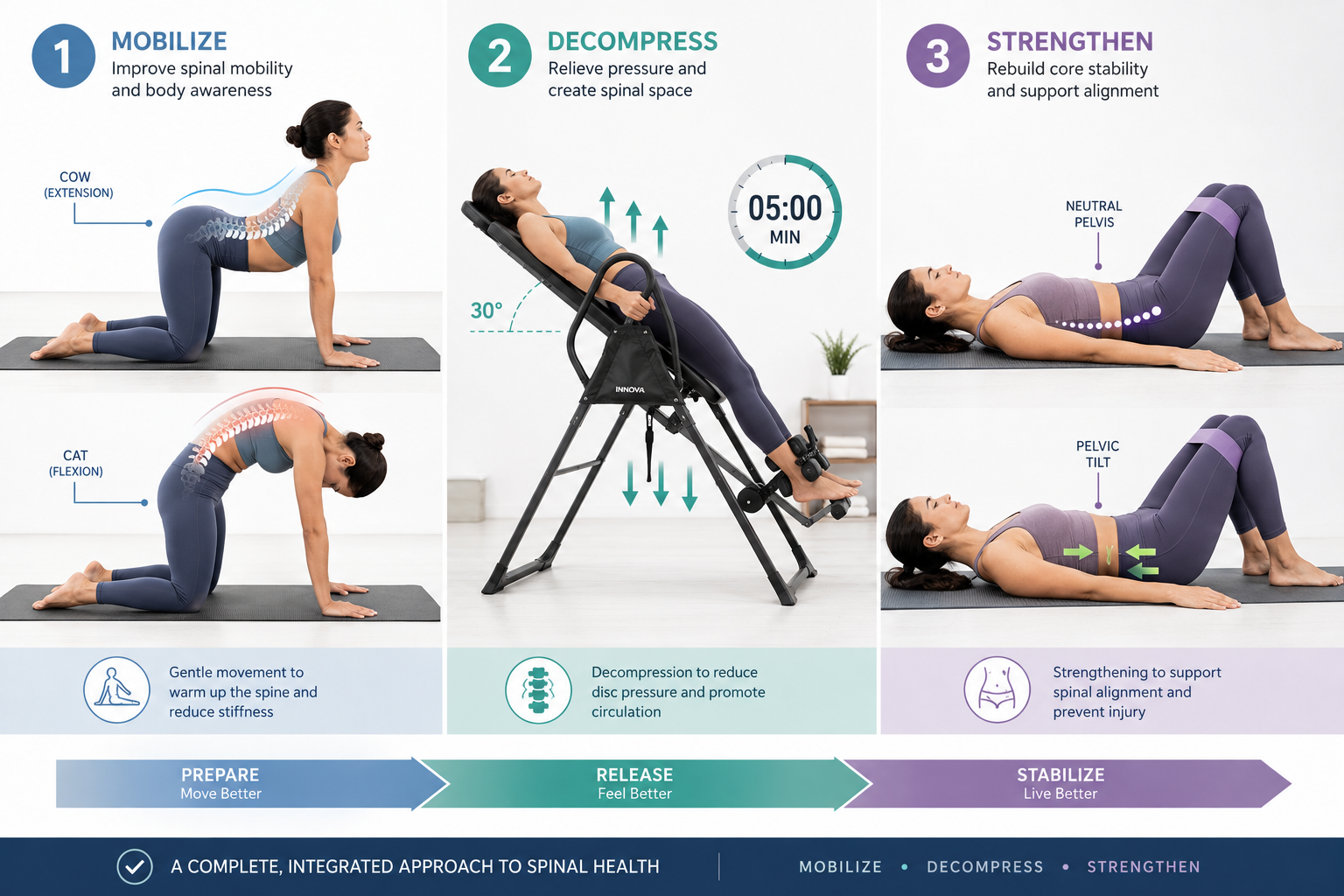
Optimal Sequencing Protocols for Combining Inversion Therapy with Yoga and Pilates
The order in which you perform these modalities significantly impacts therapeutic outcomes. Research and clinical experience establish clear sequencing guidelines that maximize benefits while minimizing injury risk.
Pre-Inversion Preparation Phase
Begin every integrated session with 5-7 minutes of gentle movement to warm tissues and increase circulation. Light yoga flows like cat-cow stretches, gentle spinal twists, and pelvic tilts prepare the spine for inversion without creating fatigue. This preparation phase increases tissue temperature by 2-3 degrees Celsius, which enhances flexibility and reduces injury risk during subsequent inversion.
Avoid intense stretching or strengthening before inversion. Deep stretches create temporary ligament laxity that reduces spinal stability during inversion. Heavy strengthening exercises cause muscle fatigue that compromises your ability to control movements on the inversion table. Save these intensive exercises for later in your sequence.
Primary Inversion Phase
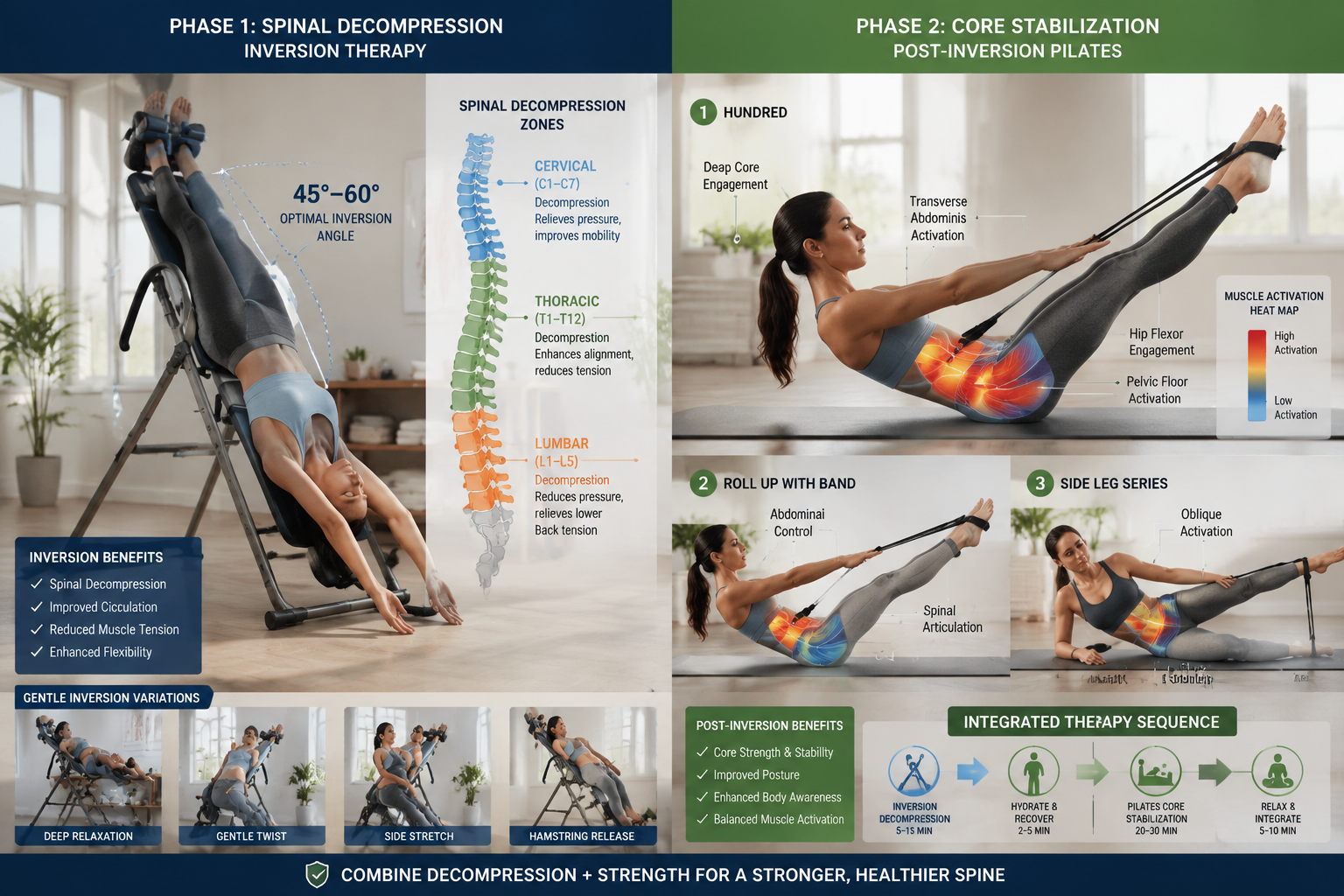
After warming up, move to the inversion table for your decompression session. Start at gentle angles (20-30 degrees) for 2-3 minutes, then progress to therapeutic angles (45-60 degrees) for 5-7 minutes. This graduated approach allows your cardiovascular system to adapt while maximizing spinal decompression benefits.
During inversion, perform gentle movements that enhance decompression effects. Slow side-to-side rotations, gentle pelvic tilts, and controlled breathing exercises amplify the therapeutic benefits. Avoid aggressive movements or sudden position changes that create shear forces on decompressed spinal segments.
For those new to inversion therapy protocols, maintain conservative angles and shorter durations initially. Build gradually over 2-3 weeks as your body adapts to inverted positioning.
Post-Inversion Yoga Phase
Immediately following inversion, your spine exists in an optimally decompressed state. This creates a therapeutic window lasting 15-20 minutes when yoga stretches achieve maximum effectiveness. The increased intervertebral spacing allows deeper, safer stretching of spinal ligaments and muscles.
Focus on yoga poses that maintain spinal length while introducing gentle flexibility work. Child’s pose, sphinx pose, and gentle supine twists work exceptionally well during this phase. These positions preserve the decompression achieved during inversion while gradually introducing range-of-motion training.
Avoid forward folds and aggressive backbends immediately post-inversion. The temporarily loosened spinal ligaments cannot provide adequate stability during extreme positions. Save these advanced poses for later in your practice when supporting muscles have been activated.
Pilates Stabilization Phase
Complete your integrated session with 15-20 minutes of Pilates exercises that strengthen the core muscles responsible for maintaining spinal alignment. The decompressed, flexible spine achieved through inversion and yoga now requires muscular support to maintain these improvements throughout your day.
Target exercises that activate the transverse abdominis, multifidus, and pelvic floor muscles. Pelvic tilts, dead bugs, bird dogs, and modified planks build the deep stabilizers that protect your spine during daily activities. These exercises “lock in” the benefits achieved during earlier phases.
Progress from basic stabilization to more dynamic movements as your session continues. Start with static holds, then add controlled movements, and finally incorporate resistance when appropriate. This progression builds both endurance and strength in the supporting musculature.
Evidence-Based Exercise Combinations That Amplify Therapeutic Benefits
Specific exercise pairings create synergistic effects that exceed the sum of individual benefits. These combinations target complementary aspects of spinal health while maintaining safety protocols.
Inversion-Enhanced Yoga Sequences
Certain yoga poses deliver dramatically enhanced benefits when performed immediately after inversion. The temporary increase in intervertebral spacing allows deeper, safer stretching of structures that typically resist lengthening.
Cat-Cow Variations Post-Inversion: Perform this fundamental spinal mobility exercise within 5 minutes of completing your inversion session. The decompressed spine moves through flexion and extension with reduced disc pressure, allowing fuller range of motion without compression risk. Execute 10-12 slow repetitions, focusing on segmental movement through each vertebral level.
Supine Spinal Twists: These gentle rotational stretches work exceptionally well post-inversion. Lie on your back, draw one knee toward your chest, then guide it across your body while keeping shoulders grounded. The decompressed spine rotates more freely, releasing tension in the deep rotator muscles. Hold each side for 60-90 seconds, breathing deeply into areas of restriction.
Sphinx to Seal Progression: This gentle backbend sequence maintains spinal length while introducing extension. Start in sphinx pose (forearms on ground, gentle backbend) for 2 minutes, then progress to seal pose (arms straight, deeper backbend) for 1-2 minutes. The post-inversion spine tolerates extension better, reducing risk of facet joint compression.
Yoga-to-Pilates Transition Exercises
Bridge the gap between flexibility and strength work with exercises that combine elements of both modalities. These transitional movements prepare your nervous system for the increased demands of Pilates stabilization work.
Dynamic Bridge Pose: This exercise combines yoga’s bridge pose with Pilates-style articulation. Lie supine with knees bent, feet flat. Slowly lift your spine off the ground one vertebra at a time, pause at the top, then lower with the same segmental control. Perform 8-10 repetitions, focusing on smooth, controlled movement. This exercise activates the posterior chain while maintaining the spinal awareness developed during yoga.
Modified Plank Series: Start in a yoga downward dog position, then shift forward into a plank hold. This transition activates core stabilizers while maintaining the length achieved through earlier stretching. Hold the plank for 20-30 seconds, return to downward dog for 10 seconds of active rest, then repeat 4-6 times.
Pilates Exercises That Protect Inversion Benefits
Select Pilates exercises that strengthen without recompressing the spine. Avoid exercises that create excessive axial loading or extreme spinal positions that could reverse decompression benefits.
Dead Bug Progressions: This fundamental core exercise builds stability without spinal compression. Lie supine with arms extended toward ceiling and knees bent at 90 degrees. Slowly lower opposite arm and leg toward the floor while maintaining neutral spine position. This exercise activates the transverse abdominis and multifidus muscles that maintain intervertebral spacing achieved during inversion.
Side-Lying Leg Series: These Pilates classics strengthen the lateral stabilizers without loading the spine. Perform leg lifts, circles, and kicks while lying on your side, maintaining perfect spinal alignment throughout. These exercises build the gluteus medius and quadratus lumborum muscles that prevent lateral spinal collapse during daily activities.
Pelvic Clock Exercise: This subtle movement pattern retrains the deep core stabilizers. Lie supine with knees bent and imagine a clock face on your pelvis. Slowly tilt your pelvis to each “hour” position, moving through the full circle in both directions. This exercise builds proprioceptive awareness and activates the stabilizers that maintain neutral spine positioning.
For individuals spending long hours seated, these protocols specifically address desk worker needs by counteracting the compressive forces of prolonged sitting.
Timing Protocols and Session Duration Guidelines
The temporal relationship between modalities significantly impacts therapeutic outcomes. Research establishes specific timing protocols that optimize benefits while preventing overtraining.
Daily Integration Schedules
Most practitioners achieve optimal results with 4-5 integrated sessions per week, allowing adequate recovery between sessions. Each complete session requires 35-45 minutes from warm-up through final stabilization exercises.
Morning Sessions: Performing integrated protocols in the morning addresses overnight spinal compression. During sleep, intervertebral discs absorb fluid and increase in height by 1-2 centimeters. Morning inversion, followed by yoga and Pilates, helps distribute this fluid optimally and establishes proper movement patterns for the day ahead.
Evening Sessions: End-of-day protocols address the cumulative compression from daily activities. By evening, the spine has lost 1-2 centimeters of height due to gravitational loading. Evening sessions restore this lost height and release accumulated tension before sleep.
Inversion Duration Recommendations
Therapeutic inversion typically requires 5-10 minutes at appropriate angles. Beginners start with 3-5 minutes at 20-30 degrees, gradually progressing to 7-10 minutes at 45-60 degrees over 2-3 weeks. Exceeding 10 minutes provides diminishing returns and increases cardiovascular stress without additional spinal benefits.
Divide longer inversion sessions into intervals. Invert for 3-4 minutes, return to horizontal for 1 minute, then invert again. This interval approach maintains therapeutic benefits while reducing cardiovascular demands and preventing excessive fluid shifts.
Yoga Phase Duration
Allocate 12-15 minutes for post-inversion yoga work. This duration provides adequate time for 4-6 poses held for 1-3 minutes each. Longer holds allow connective tissue to respond to stretching forces, creating lasting flexibility improvements rather than temporary muscle relaxation.
Focus on quality over quantity during this phase. Three poses performed with excellent form and mindful breathing deliver better results than ten poses rushed through without attention to alignment and breath work.
Pilates Stabilization Duration
Complete your session with 15-20 minutes of Pilates exercises. This timeframe allows for 6-8 exercises performed for 2-3 sets each. Adequate volume builds both strength and endurance in the stabilizing muscles without creating excessive fatigue.
Progressive sessions gradually increase difficulty rather than duration. Maintain the 15-20 minute timeframe but advance to more challenging exercise variations as your strength improves.
Condition-Specific Protocols for Enhanced Spinal Health
Different spinal conditions require modified integration protocols. These adaptations maintain therapeutic benefits while respecting the unique limitations of each condition.
Herniated Disc Protocols
Herniated discs respond exceptionally well to integrated protocols, but require specific modifications. Avoid yoga poses that create excessive flexion (forward bending), as these positions increase intradiscal pressure and may worsen disc herniation.
Modified Sequence: Begin with gentle inversion at 30-40 degrees for 5-7 minutes, focusing on the decompression effect. Follow with extension-based yoga poses (sphinx, cobra, prone press-ups) that encourage posterior disc migration away from nerve roots. Complete with Pilates exercises emphasizing neutral spine positioning and avoiding flexion-based movements.
Research demonstrates that this extension-biased approach, combined with decompression, reduces herniation symptoms more effectively than flexion-based protocols. The comparison between inversion tables and other decompression devices shows similar outcomes when proper protocols guide usage.
Sciatica Management Protocols
Sciatica often results from nerve root compression that responds well to decompression combined with neural mobilization exercises. The integrated approach addresses both the mechanical compression and the neural tissue restriction.
Modified Sequence: Start with inversion at 45-60 degrees for 7-10 minutes, maximizing decompression at the affected spinal level. Follow with gentle yoga poses that mobilize neural tissue, including supine hamstring stretches, piriformis stretches, and gentle spinal twists. Avoid aggressive stretching that creates sharp pain or radiating symptoms. Complete with Pilates exercises that strengthen the core without creating nerve tension.
Include neural flossing techniques during the yoga phase. These gentle movements mobilize nerve tissue through its surrounding structures, reducing adhesions that contribute to sciatic symptoms. Perform these techniques slowly and stop immediately if symptoms increase.
Degenerative Disc Disease Protocols
Degenerative disc disease requires protocols that maximize hydration and nutrition delivery to damaged discs while building the muscular support that reduces mechanical stress.
Modified Sequence: Perform longer inversion sessions (8-10 minutes) at moderate angles (40-50 degrees) to maximize the imbibition effect that draws fluid into degenerated discs. Follow with gentle yoga movements that distribute this fluid throughout the disc matrix without creating excessive loading. Complete with extensive Pilates work (20-25 minutes) that builds the muscular support system essential for protecting degenerated discs during daily activities.
Focus on exercises that activate the deep stabilizers (transverse abdominis, multifidus) rather than the global movers (rectus abdominis, erector spinae). Deep stabilizers provide the constant, low-level activation that protects degenerated discs throughout the day.
Postural Dysfunction Protocols
Forward head posture, hyperkyphosis, and other postural dysfunctions respond well to integrated protocols emphasizing extension and posterior chain strengthening.
Modified Sequence: Begin with inversion at 30-45 degrees, focusing on cervical and thoracic decompression. Follow with yoga poses that emphasize extension and chest opening, including cobra pose, camel pose, and supported bridge variations. Complete with Pilates exercises targeting the posterior chain and scapular stabilizers, including prone extensions, reverse planks, and scapular retraction exercises.
Include specific cervical traction during inversion by gently pulling your head away from your shoulders while inverted. This technique enhances decompression in the cervical spine, addressing the forward head posture that affects many desk workers.
Safety Considerations and Contraindications for Integrated Protocols
Combined protocols require careful attention to safety guidelines that protect against adverse events. Understanding contraindications and warning signs prevents complications while maximizing therapeutic benefits.
Absolute Contraindications
Certain conditions prohibit inversion therapy and therefore preclude integrated protocols. These include uncontrolled hypertension, glaucoma, retinal detachment, cerebral sclerosis, recent stroke, heart disease, hiatal hernia, and pregnancy. The complete medical contraindications checklist provides comprehensive guidance for determining eligibility.
Individuals with these conditions should pursue alternative approaches that provide similar benefits without inversion. Yoga and Pilates alone offer substantial spinal health benefits when inversion remains contraindicated.
Relative Contraindications
Some conditions require medical clearance and modified protocols rather than complete avoidance. These include controlled hypertension, obesity, osteoporosis, and previous spinal surgery. Consult healthcare providers before beginning integrated protocols if you have any of these conditions.
Modified protocols for relative contraindications typically involve gentler inversion angles (15-30 degrees), shorter durations (3-5 minutes), and more conservative exercise selections. These modifications maintain therapeutic benefits while respecting individual limitations.
Warning Signs During Practice
Stop immediately if you experience sharp pain, radiating symptoms, dizziness, visual changes, or cardiovascular symptoms during any phase of your integrated session. These warning signs indicate that your current protocol exceeds your body’s current tolerance.
Mild muscle soreness and temporary fatigue represent normal responses to therapeutic exercise. Sharp pain, numbness, tingling, or weakness indicate potential tissue damage or nerve compression that requires protocol modification or medical evaluation.
Progressive Adaptation Guidelines
Your body requires 2-4 weeks to adapt to integrated protocols. Begin conservatively with shorter durations, gentler angles, and basic exercises. Progress gradually as your tolerance improves, adding 1-2 minutes of inversion time or advancing to more challenging exercises every 5-7 days.
Track your response to each session, noting pain levels, range of motion improvements, and functional capacity changes. This data guides progression decisions and helps identify which protocol elements deliver the greatest benefits for your specific condition.
Equipment Considerations and Setup Optimization
Proper equipment selection and setup significantly impact the safety and effectiveness of integrated protocols. Invest in quality equipment that supports your practice over years of consistent use.
Inversion Table Selection
Choose an inversion table that accommodates your height and weight while providing smooth, controlled inversion. Look for models with adjustable ankle supports, comfortable backrest padding, and reliable angle control mechanisms. The comparison between budget and premium models helps identify features that justify higher investment.
Consider tables with additional features that enhance integrated protocols. Some models include handlebar attachments that facilitate inverted stretching, while others offer heat therapy options that enhance muscle relaxation during decompression.
Yoga Equipment Requirements
Quality yoga mats provide adequate cushioning and grip for post-inversion practice. Choose mats at least 6mm thick to protect joints during floor-based exercises. Non-slip surfaces prevent dangerous sliding during poses that require stability.
Props including blocks, straps, and bolsters enhance your ability to perform poses with proper alignment. These tools prove especially valuable during the post-inversion phase when your body exists in an unfamiliar state of decompression.
Pilates Equipment Options
Mat-based Pilates requires minimal equipment beyond a quality exercise mat. Small props including resistance bands, small balls, and foam rollers enhance exercise variety and progression options.
For those investing in equipment, a Pilates reformer provides additional exercise options that complement inversion and yoga work. However, comprehensive protocols work effectively with mat-based exercises alone, making reformer equipment optional rather than essential.
Space Planning and Setup
Integrated protocols require adequate space for all three modalities. Allocate a 10×10 foot area that accommodates your inversion table with clearance for full inversion, plus floor space for yoga and Pilates work. This dedicated space eliminates setup time and encourages consistent practice.
Position your inversion table near your mat space to minimize transition time between modalities. Quick transitions maintain the therapeutic window when post-inversion tissues remain optimally decompressed.
Long-Term Progression and Advanced Integration Strategies
As your body adapts to basic integrated protocols, advanced strategies maintain progression and prevent plateaus. These techniques challenge your system in new ways while building on established foundations.
Progressive Overload Principles
Apply progressive overload by gradually increasing inversion angles, extending duration, advancing exercise difficulty, or adding resistance to Pilates movements. Increase only one variable at a time, allowing 1-2 weeks of adaptation before making additional changes.
Track your progression using a training log that records inversion angles, durations, exercises performed, and subjective response ratings. This data reveals patterns and guides intelligent progression decisions.
Advanced Inversion Techniques
Once you master basic inversion, incorporate advanced techniques that enhance therapeutic effects. Perform gentle yoga stretches while inverted, including spinal twists, side bends, and hip openers. These inverted stretches create unique decompression patterns unavailable in upright positions.
Add oscillation techniques that involve gentle bouncing movements while inverted. These rhythmic movements enhance fluid exchange in intervertebral discs and create a pumping effect that accelerates nutrient delivery to spinal tissues.
Complex Movement Patterns
Progress from isolated exercises to complex movement patterns that integrate multiple muscle groups and movement planes. Yoga flows that transition smoothly between poses build functional movement capacity. Pilates sequences that combine multiple exercises without rest develop muscular endurance and motor control.
These complex patterns prepare your body for the unpredictable demands of daily life, where movements rarely occur in isolation. The improved motor control and muscular coordination transfer directly to functional activities.
Periodization Strategies
Implement periodization by varying your protocol emphasis throughout the year. Spend 4-6 weeks emphasizing decompression and flexibility, then shift focus to stabilization and strength for the next 4-6 weeks. This cyclical approach prevents adaptation plateaus while addressing all aspects of spinal health.
Periodization also accommodates life circumstances. During high-stress periods, emphasize relaxation and gentle stretching. When preparing for physically demanding activities, increase stabilization and strengthening work.
Measuring Progress and Adjusting Protocols
Objective measurement guides protocol adjustments and demonstrates the effectiveness of your integrated approach. Track multiple metrics that capture different aspects of spinal health improvement.
Quantitative Measurements
Measure spinal range of motion using simple tests. Record how far you can reach toward your toes during a forward bend, how far you can rotate your trunk to each side, and how far you can extend backward. Perform these measurements weekly, tracking improvements over time.
Track pain levels using a 0-10 numeric rating scale. Record your pain level before and after each session, plus your average daily pain level. Declining pain scores demonstrate protocol effectiveness.
Functional Assessments
Monitor functional capacity by tracking activities that your back pain previously limited. Can you sit longer without discomfort? Walk further? Perform household tasks with less difficulty? These functional improvements often matter more than objective measurements.
Assess your quality of life using standardized questionnaires like the Oswestry Disability Index. These validated tools quantify how back pain impacts your daily activities, providing objective data about your progress.
Protocol Adjustment Guidelines
Adjust your protocol when progress stalls or symptoms change. If pain levels plateau after initial improvements, increase inversion duration or advance to more challenging exercises. If symptoms worsen, reduce intensity and return to more conservative approaches.
Consider consulting healthcare professionals when progress stalls despite protocol adjustments. Physical therapists, chiropractors, or physicians specializing in spine care can identify factors limiting your progress and suggest targeted modifications.
Conclusion
Combining inversion therapy with yoga and Pilates creates a comprehensive approach to spinal health that addresses decompression, flexibility, and stabilization simultaneously. This integrated strategy delivers superior outcomes compared to single-modality approaches, with research and clinical experience supporting specific sequencing protocols that maximize benefits while maintaining safety.
The optimal sequence begins with gentle warm-up movements, progresses to therapeutic inversion for 5-10 minutes, continues with yoga stretches that capitalize on the decompressed state, and concludes with Pilates exercises that stabilize and strengthen supporting muscles. This progression respects the biomechanical requirements of spinal tissues while building cumulative benefits over weeks and months of consistent practice.
Condition-specific modifications adapt these general protocols to individual needs, whether addressing herniated discs, sciatica, degenerative disc disease, or postural dysfunction. Safety guidelines and contraindication awareness protect against adverse events while progressive strategies prevent plateaus and maintain long-term improvements.
Start your integrated practice conservatively, building gradually as your body adapts. Track your progress using both objective measurements and functional assessments. Adjust your protocol based on your response, and consult healthcare professionals when needed. With consistent application of these evidence-based protocols, you can achieve lasting improvements in spinal health that enhance your quality of life and functional capacity.
Begin today by selecting appropriate equipment, establishing a dedicated practice space, and committing to 4-5 weekly sessions. The investment of 35-45 minutes per session delivers returns in reduced pain, improved function, and enhanced overall well-being that compound over time.
SEO Meta Title: Inversion Therapy with Yoga & Pilates: Spinal Protocol