Quick Answer
Inversion table therapy uses gravity to decompress your spine by tilting your body at angles between 20 and 90 degrees, creating space between vertebrae and reducing pressure on discs and nerve roots. Research shows patients with lumbar disc disease who used inversion therapy were 50% less likely to need surgery compared to those who didn’t, though evidence for general back pain remains mixed. The therapy works best for disc-related conditions like sciatica when combined with physical therapy, but it carries significant risks for people with high blood pressure, glaucoma, heart disease, or osteoporosis.
Key Takeaways
Inversion table therapy reduces surgical need by 50% in patients with lumbar disc disease and sciatica, according to Newcastle University research tracking outcomes over four years
Start with 20-30 degree angles for 30-60 seconds and gradually progress to 40-60 degrees for 3-5 minutes maximum per session to avoid adverse effects
People with high blood pressure, glaucoma, heart disease, stroke history, or osteoporosis should not use inversion tables due to increased blood pressure and eye pressure during inversion
Combine inversion therapy with physical therapy, core strengthening, and stretching rather than using it as a standalone treatment for optimal results
Evidence supports disc-related conditions more than general back pain, with strongest results for herniated discs compressing nerve roots
Common mistakes include inverting too long, starting at steep angles, and skipping medical clearance before beginning therapy
Partial inversion (20-60 degrees) provides most therapeutic benefits without the risks associated with full inversion
Sessions should occur 1-3 times daily with at least 4 hours between to allow your body to adapt and prevent overuse

What Is Inversion Table Therapy and How Does It Work?
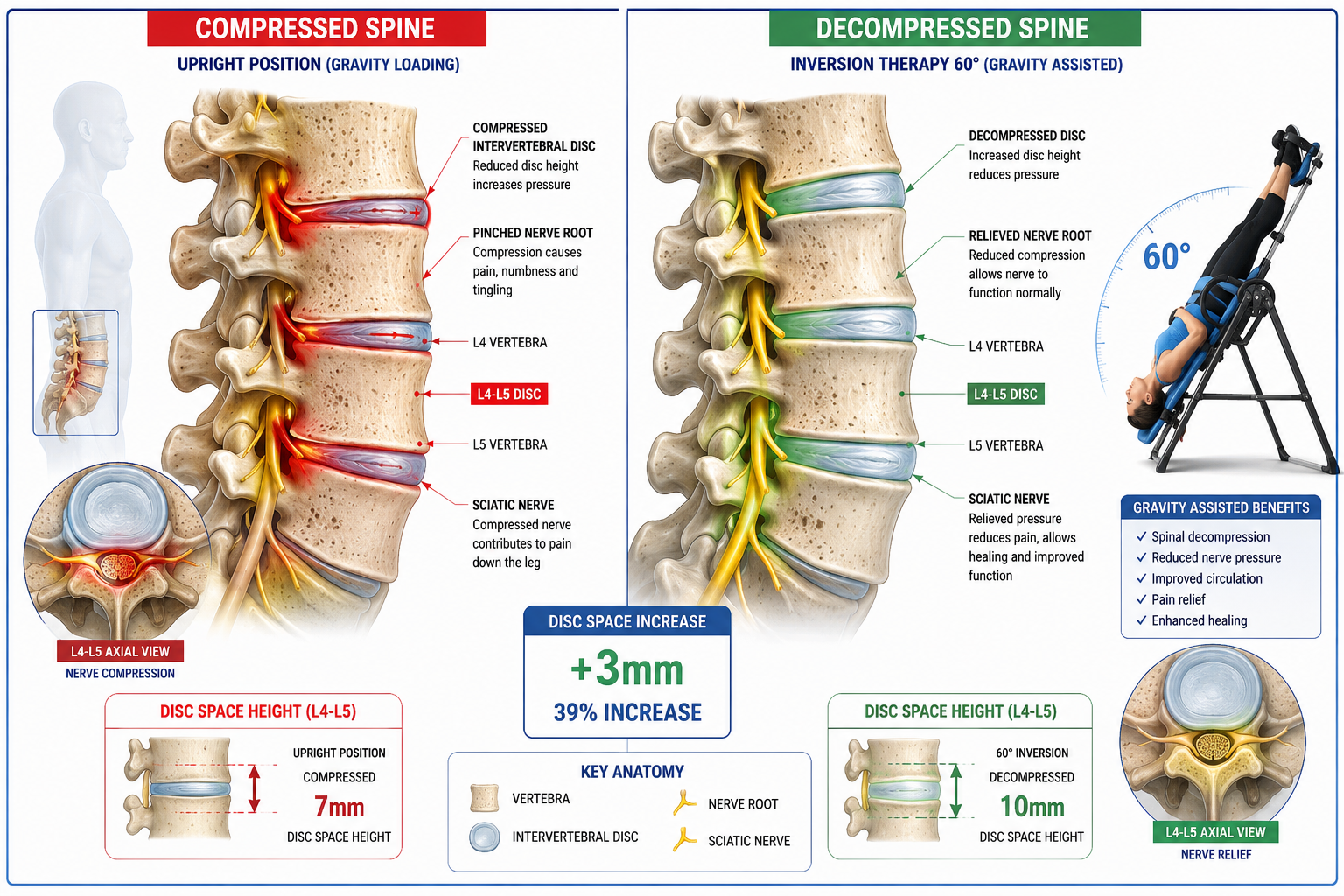
Inversion table therapy applies controlled gravitational force to your spine by positioning your body at an inverted angle, creating traction that separates vertebrae and reduces compression on intervertebral discs. Think of your spine like a stack of sponges with water squeezed out—inversion lets gravity pull those sponges apart so they can rehydrate and expand. The therapy works by reversing the constant downward pressure gravity places on your spine throughout the day, allowing discs to decompress and nerve roots to experience less pressure.
The mechanism operates through passive traction. When you invert, your body weight creates a gentle pulling force along your spine’s length. This force:
Increases intervertebral space by 2-3mm between compressed vertebrae
Reduces pressure on nerve roots that cause radiating pain down your legs
Improves circulation to disc tissues that normally receive limited blood flow
Stretches paraspinal muscles that often spasm and contribute to pain
Stimulates lymphatic drainage to remove inflammatory byproducts from affected areas
Modern inversion tables feature adjustable ankle supports, angle control systems, and safety straps. You secure your ankles, cross your arms, and lean back to reach your desired angle. The table rotates smoothly, allowing you to control the degree of inversion from slight tilts to full inversion.
Choose inversion therapy if you have disc-related back pain with nerve involvement (sciatica), have tried conservative treatments without full relief, and have medical clearance from your healthcare provider. For more background on various causes of back pain, see our guide on common causes of back pain.
Inversion Table Benefits for Lower Back Pain
Inversion table therapy delivers measurable relief for lower back pain primarily through spinal decompression and reduced nerve root pressure. A Newcastle University study tracking patients with lumbar disc disease found that 43% of control patients required surgery within four years, while only 21% of inversion therapy users needed surgical intervention over two years—demonstrating a significant protective effect against disease progression.
The documented benefits include:
Pain Reduction
Decreases pressure on compressed nerve roots causing sciatica
Reduces mechanical stress on facet joints
Alleviates muscle tension in the lower back and hips
Provides temporary relief lasting 2-8 hours after sessions
Functional Improvement
Increases range of motion in the lumbar spine
Improves ability to perform daily activities without pain
Reduces reliance on pain medications for some users
Enhances sleep quality by reducing nighttime discomfort
Structural Benefits
Creates space for herniated disc material to retract from nerve pathways
Allows nutrient-rich fluid to enter dehydrated discs
Reduces inflammation around compressed nerve roots
Maintains disc height over time with consistent use
The evidence shows strongest support for disc-related conditions with nerve compression, not general nonspecific back pain. Patients already considering surgery for herniated discs saw the most dramatic benefits. For comprehensive information on how inversion therapy specifically helps back pain, review our detailed article on benefits of inversion therapy for lasting back relief.
Common mistake: Expecting inversion therapy alone to cure chronic back pain. The Newcastle study patients received inversion therapy as part of a comprehensive treatment plan including physical therapy and exercise—not as a replacement for other conservative care.
Is Inversion Table Therapy Safe for Everyone?
Inversion table therapy poses significant risks for people with cardiovascular conditions, eye disorders, bone density issues, and certain neurological conditions because inversion increases blood pressure and intraocular pressure. Medical experts consistently warn that this therapy is not appropriate for everyone, and some individuals should never use inversion tables regardless of their back pain severity.
Absolute contraindications (never use inversion tables if you have):
High blood pressure or hypertension – Inversion raises blood pressure by 20-30 mmHg, potentially triggering cardiovascular events
Glaucoma or retinal detachment history – Increased eye pressure can damage the optic nerve or worsen existing eye conditions
Heart disease or recent heart attack – Additional cardiovascular stress can trigger arrhythmias or ischemic events
Stroke history or cerebrovascular disease – Increased blood flow to the brain may cause complications
Osteoporosis or bone fragility – Risk of fractures from the forces applied during inversion
Pregnancy – Potential harm to the fetus and increased maternal discomfort
Hiatal hernia or severe acid reflux – Inversion worsens reflux symptoms significantly
Relative contraindications (use only with medical supervision):
Obesity (may exceed table weight limits and increase cardiovascular stress)
Middle ear infections or balance disorders (can worsen dizziness)
Spinal instability or spondylolisthesis (may worsen vertebral slippage)
Recent spinal surgery (typically wait 6-12 months post-surgery)
Use of anticoagulant medications (increased bleeding risk)
For detailed safety information specific to hypertension, consult our comprehensive guide on inversion tables and blood pressure safety.
Edge case: Some people with well-controlled hypertension may use inversion therapy at very shallow angles (15-20 degrees) with their cardiologist’s approval and blood pressure monitoring before and after sessions. This requires individualized medical assessment—never self-prescribe this approach.
Who Should Not Use an Inversion Table?
Specific populations should avoid inversion table therapy entirely due to elevated risk of serious complications including stroke, retinal damage, bone fractures, and cardiovascular events. The contraindications extend beyond the cardiovascular and eye conditions mentioned above to include anatomical, medication-related, and situational factors.
Additional groups who should not use inversion tables:
People over 65 with multiple health conditions – Age-related changes in blood vessel elasticity increase stroke risk
Individuals taking blood thinners (warfarin, apixaban, rivaroxaban) – Increased risk of intracranial bleeding
Those with spinal hardware or fusion – Metal implants may shift or cause pain under traction forces
People with severe obesity (exceeding table weight capacity, typically 250-350 lbs) – Structural failure risk and excessive cardiovascular stress
Individuals with ventral hernias – Inversion increases intra-abdominal pressure and hernia protrusion
Those with uncontrolled seizure disorders – Risk of injury if seizure occurs during inversion
People with severe anxiety or claustrophobia – Psychological distress can trigger panic attacks
Medication interactions to consider:
Certain medications amplify inversion therapy risks. Blood pressure medications may not prevent the acute spike during inversion. Anticoagulants increase bleeding risk if minor trauma occurs. Medications affecting balance (sedatives, muscle relaxants) increase fall risk during table use.
For a complete safety assessment, see our detailed guide on who should not use an inversion table.
Decision rule: If you have any condition that affects blood pressure, eye pressure, bone strength, or balance, consult your physician and obtain written clearance before purchasing or using an inversion table. The potential for serious harm outweighs the back pain relief benefits for high-risk individuals.
How Long Should You Hang Upside Down on an Inversion Table?
Beginners should start with 30-60 seconds at 20-30 degree angles and gradually progress to 3-5 minutes at 40-60 degrees over several weeks, with most experts recommending a maximum of 5 minutes per session to avoid adverse effects. Extended inversion beyond this duration increases risks of nausea, dizziness, excessive blood pooling in the head, and elevated blood pressure without providing additional therapeutic benefits.
Recommended progression schedule:
Week 1-2: Adaptation Phase
Duration: 30-60 seconds per session
Angle: 15-20 degrees
Frequency: Once daily
Goal: Allow your body to adapt to inverted position
Week 3-4: Building Tolerance
Duration: 1-2 minutes per session
Angle: 25-40 degrees
Frequency: 1-2 times daily
Goal: Increase comfort and assess response
Week 5+: Therapeutic Phase
Duration: 3-5 minutes per session
Angle: 40-60 degrees
Frequency: 1-3 times daily (minimum 4 hours between sessions)
Goal: Achieve maximum decompression benefits
Time limits by condition:
ConditionMaximum DurationOptimal AngleSessions Per DayHerniated disc with sciatica5 minutes40-60 degrees2-3General lower back pain3 minutes30-45 degrees1-2Maintenance/prevention2 minutes20-40 degrees1Post-workout recovery2-3 minutes30-50 degrees1
For comprehensive guidance on session duration and progression, review our article on how long to hang on an inversion table.
Common mistake: Staying inverted too long during initial sessions. New users often think “more is better” and remain inverted for 10-15 minutes, leading to severe headaches, nausea, and blood pressure spikes that discourage continued use. Start conservatively and progress slowly.
Edge case: Athletes using inversion for post-workout recovery may benefit from shorter, more frequent sessions (1-2 minutes, 3-4 times daily) rather than longer single sessions. This approach provides decompression without excessive cardiovascular stress.
Can Inversion Tables Make Back Pain Worse?
Inversion tables can worsen back pain when used incorrectly, at excessive angles, for too long, or by people with conditions that respond poorly to traction forces. Approximately 10-15% of users report increased pain during or after initial sessions, typically due to improper technique, underlying spinal instability, or conditions that contraindicate traction therapy.
Situations where inversion worsens pain:
Acute muscle spasm: Inverting during active muscle spasm can increase protective muscle guarding and intensify pain. Wait until acute spasm resolves before starting inversion therapy.
Spinal instability: Conditions like spondylolisthesis (vertebral slippage) or ligamentous laxity may worsen with traction forces that pull unstable segments apart.
Facet joint arthritis: Some people with severe facet joint degeneration experience increased pain from the stretching forces applied to inflamed joints.
Improper body positioning: Twisting while inverted, tensing muscles instead of relaxing, or inverting with poor ankle support creates uneven forces that strain tissues.
Too steep, too soon: Jumping to 60-90 degree angles before your body adapts causes excessive muscle stretch and protective spasm.
Warning signs to stop immediately:
Sharp, shooting pain down your legs (different from your baseline pain)
Severe headache or pressure in your head
Dizziness, nausea, or visual disturbances
Numbness or tingling that worsens during inversion
Chest pain or difficulty breathing
Pain that persists more than 2 hours after your session
If you experience lower back pain during or after inversion therapy, consult our troubleshooting guide on why your inversion table hurts your lower back.
Decision rule: If pain increases during three consecutive properly performed sessions at conservative angles (20-30 degrees for 1-2 minutes), inversion therapy may not be appropriate for your specific condition. Consult a physical therapist or spine specialist for alternative treatments.
Inversion Table vs Physical Therapy for Herniated Disc
Inversion table therapy and physical therapy serve complementary rather than competing roles in herniated disc treatment, with research showing the best outcomes occur when patients combine both approaches rather than choosing one over the other. Physical therapy addresses muscle imbalances, movement patterns, and core stability that inversion therapy cannot improve, while inversion provides passive decompression that physical therapy exercises alone may not achieve.
Comparative effectiveness:
Inversion Table Therapy:
Provides passive spinal decompression without active effort
Reduces nerve root pressure through gravitational traction
Offers immediate temporary relief (2-8 hours)
Requires 3-10 minutes per session
Costs $100-400 one-time equipment purchase
Does not improve core strength or movement patterns
Cannot address muscle imbalances or postural dysfunction
Physical Therapy:
Teaches active exercises that strengthen supporting muscles
Addresses root causes like weak core, tight hip flexors, poor posture
Provides longer-lasting functional improvements
Requires 30-60 minutes per session, 2-3 times weekly
Costs $75-200 per session (often insurance-covered)
Improves body mechanics to prevent future injury
Includes manual therapy techniques for immediate relief
The Newcastle study’s key finding: Patients who used inversion therapy were already receiving standard conservative care including physical therapy. The 50% reduction in surgery rate came from adding inversion to their existing treatment plan, not replacing physical therapy with inversion.
For detailed comparison, see our analysis of inversion tables vs traditional physical therapy.
Optimal approach: Use inversion therapy 1-2 times daily for symptom relief while attending physical therapy sessions 2-3 times weekly to address underlying dysfunction. The combination provides both immediate decompression and long-term functional improvement.
Inversion Table vs Decompression Therapy
Inversion tables and clinical spinal decompression therapy both create traction forces to separate vertebrae, but clinical decompression uses computerized equipment to apply precise, oscillating forces while inversion relies on gravity and body weight for constant traction. Clinical decompression typically costs $3,000-6,000 for a treatment series, while inversion tables cost $100-400 for unlimited home use, making them vastly different in precision, cost, and accessibility.
Key differences:
FeatureInversion TableClinical DecompressionForce controlBody weight onlyComputer-controlled, preciseForce patternConstantOscillating (on/off cycles)TargetingWhole spineSpecific spinal segmentsCost$100-400 one-time$3,000-6,000 seriesLocationHome useClinical settingSupervisionSelf-administeredClinician-monitoredTreatment time3-5 minutes20-30 minutesEvidence qualityModerateLimited
Clinical decompression advantages:
Clinical decompression machines apply intermittent traction that alternates between pulling and releasing, which theoretically reduces protective muscle guarding better than constant traction. The computerized control allows precise force adjustment and targeting of specific disc levels. Treatment occurs under professional supervision with immediate adjustments if problems arise.
Inversion table advantages:
Inversion tables cost 90% less than clinical decompression series and provide unlimited treatments at home. You control the angle and duration, allowing personalized adjustment based on daily symptoms. The equipment serves multiple family members and lasts for years with minimal maintenance.
Evidence comparison:
Neither therapy has overwhelming research support. The Newcastle study provides the strongest evidence for inversion therapy’s effect on surgical rates in disc disease patients. Clinical decompression studies show mixed results, with some demonstrating short-term pain relief but limited long-term benefit compared to standard physical therapy.
Decision rule: Start with inversion therapy if you have disc-related back pain, no contraindications, and want an affordable home option. Consider clinical decompression if you’ve tried inversion without adequate relief, need more precise targeting, or prefer professional supervision during treatment.
Common Mistakes When Using an Inversion Table
Users frequently make preventable errors that reduce effectiveness, increase injury risk, and cause them to abandon inversion therapy prematurely. The most common mistakes involve progression speed, body positioning, session timing, and unrealistic expectations about results.
Top mistakes and corrections:
1. Starting too steep, too fast
Mistake: Inverting to 60-90 degrees on first use
Consequence: Severe headache, nausea, muscle strain, fear of continued use
Correction: Begin at 15-20 degrees for 30-60 seconds, progress 5-10 degrees weekly
2. Tensing muscles during inversion
Mistake: Gripping handles tightly, holding breath, tensing core
Consequence: Prevents muscle relaxation needed for decompression
Correction: Breathe deeply, let arms hang loosely, consciously relax all muscles
3. Inverting immediately after eating
Mistake: Using table within 1-2 hours of meals
Consequence: Severe acid reflux, nausea, vomiting
Correction: Wait at least 2 hours after eating before inverting
4. Skipping medical clearance
Mistake: Starting therapy without consulting healthcare provider
Consequence: Undetected contraindications lead to serious complications
Correction: Obtain written clearance, especially if you have any chronic conditions
5. Improper ankle support adjustment
Mistake: Ankle supports too loose or too tight
Consequence: Slipping out (injury risk) or restricted circulation (numbness)
Correction: Adjust so supports hold firmly but comfortably without pressure points
6. Twisting or reaching while inverted
Mistake: Attempting stretches or reaching for objects during inversion
Consequence: Uneven spinal forces cause muscle strain or disc injury
Correction: Remain still with body aligned, perform stretches only when upright
7. Expecting immediate cure
Mistake: Believing 1-2 sessions will eliminate chronic pain
Consequence: Premature discontinuation when instant results don’t occur
Correction: Commit to 4-6 weeks of consistent use before assessing effectiveness
8. Using damaged or improperly assembled equipment
Mistake: Skipping assembly instructions or ignoring wear on parts
Consequence: Equipment failure causing falls and serious injury
Correction: Follow assembly instructions precisely, inspect equipment monthly
For comprehensive usage guidance, review our article on how to use an inversion table safely and effectively.
Edge case: Some users experience increased pain not from technique errors but from underlying conditions that contraindicate traction. If you follow proper technique for 2-3 weeks without improvement or with worsening symptoms, consult a spine specialist to rule out conditions like spinal instability or severe stenosis.

Can You Use an Inversion Table with High Blood Pressure?
People with high blood pressure should not use inversion tables without explicit approval from their cardiologist because inversion acutely raises blood pressure by 20-30 mmHg, potentially triggering hypertensive crisis, stroke, or cardiovascular events. Even well-controlled hypertension on medication does not eliminate this risk, as the blood pressure spike during inversion occurs regardless of baseline control.
Why inversion raises blood pressure:
When you invert, gravity pulls blood toward your head and upper body. Your cardiovascular system responds by:
Increasing heart rate to maintain circulation
Constricting blood vessels to prevent excessive pooling
Elevating systemic blood pressure to ensure adequate brain perfusion
Raising intraocular pressure as blood accumulates in eye vessels
These responses occur in everyone but pose particular danger for people with:
Uncontrolled hypertension (readings consistently above 140/90)
Stage 2 hypertension (readings above 160/100)
Hypertensive heart disease (left ventricular hypertrophy)
History of hypertensive crisis or stroke
Resistant hypertension requiring multiple medications
Possible exceptions (requires medical supervision):
Some individuals with well-controlled Stage 1 hypertension (130-139/80-89) may receive clearance for very limited inversion therapy under specific conditions:
Maximum angle of 15-20 degrees (partial inversion only)
Maximum duration of 1-2 minutes
Blood pressure monitoring before and after each session
Immediate discontinuation if readings exceed 140/90 post-session
Regular follow-up with cardiologist to assess ongoing safety
For comprehensive safety information, consult our detailed guide on inversion tables and blood pressure.
Warning signs during inversion:
Stop immediately and seek medical attention if you experience:
Severe headache or pressure in your head
Visual disturbances (blurred vision, spots, flashing lights)
Chest pain or tightness
Shortness of breath
Irregular heartbeat or palpitations
Dizziness that persists after returning upright
Decision rule: If you have any history of high blood pressure, even if currently controlled with medication, do not use an inversion table without written clearance from your cardiologist. The potential for serious cardiovascular complications outweighs the back pain relief benefits.
How Often Should You Use an Inversion Table for Sciatica?
For sciatica caused by herniated discs compressing nerve roots, use an inversion table 2-3 times daily at 40-60 degree angles for 3-5 minutes per session, with at least 4 hours between sessions to allow tissues to respond to decompression. This frequency provides consistent nerve root pressure relief while avoiding overuse that can cause muscle soreness or cardiovascular stress.
Optimal frequency by treatment phase:
Acute Phase (First 2-4 weeks):
Frequency: 2-3 times daily
Duration: 3-5 minutes per session
Angle: 40-60 degrees
Timing: Morning, midday, evening (space 4-6 hours apart)
Goal: Reduce acute nerve compression and inflammation
Improvement Phase (Weeks 4-8):
Frequency: 1-2 times daily
Duration: 3-5 minutes per session
Angle: 40-60 degrees
Timing: Morning and/or evening
Goal: Maintain decompression while tissues heal
Maintenance Phase (After 8 weeks):
Frequency: 3-5 times weekly
Duration: 2-3 minutes per session
Angle: 30-50 degrees
Timing: As needed for symptom management
Goal: Prevent symptom recurrence
Best timing for sessions:
Morning: Helps counteract overnight disc compression and reduces morning stiffness. Wait 30 minutes after waking to allow blood pressure to stabilize.
Midday: Provides relief from prolonged sitting or standing during work hours. Particularly beneficial for desk workers.
Evening: Reduces accumulated daily compression and improves sleep quality. Complete at least 2 hours before bedtime to allow blood pressure to normalize.
Response indicators:
Track these metrics to assess whether your frequency is appropriate:
Pain reduction: Should notice 20-40% improvement within 2-3 weeks
Functional improvement: Increased walking distance, reduced leg pain
Session tolerance: No headaches, dizziness, or excessive soreness
Sustained relief: Benefits lasting 4-8 hours between sessions
Adjust frequency if:
Pain worsens: Reduce to once daily or decrease angle
No improvement after 3 weeks: Consult healthcare provider
Excessive headaches: Reduce frequency or duration
Complete relief: Transition to maintenance schedule
For additional guidance on sciatica relief, see our article on inversion therapy benefits for back pain.
Edge case: Some people with severe acute sciatica may benefit from 4-5 brief sessions (1-2 minutes) daily during the first week, then consolidating to 2-3 longer sessions as symptoms improve. This approach provides frequent decompression without excessive duration per session.
Do Chiropractors Recommend Inversion Tables?
Many chiropractors recommend inversion tables as a complementary home therapy for patients with disc-related back pain and sciatica, viewing them as a tool to extend the benefits of spinal adjustments between office visits. However, chiropractor opinions vary based on their treatment philosophy, with some enthusiastically endorsing inversion therapy while others prefer alternative decompression methods or express concerns about patient safety with unsupervised home use.
Chiropractor perspectives:
Supportive chiropractors (approximately 60-70% based on professional surveys) recommend inversion tables because:
Extends decompression benefits between adjustment appointments
Provides patients with active self-care tool
Reduces frequency of office visits needed for symptom management
Complements manual adjustments by maintaining spinal mobility
Offers cost-effective alternative to clinical decompression tables
Cautious chiropractors (approximately 20-30%) express reservations including:
Concern about patients using tables without proper instruction
Preference for supervised clinical decompression with precise control
Worry about contraindications patients may not disclose
Belief that manual adjustments provide superior targeted treatment
Concern about liability if patients injure themselves at home
Chiropractors who don’t recommend (approximately 10%) typically:
Focus exclusively on manual adjustment techniques
Prefer active exercise-based rehabilitation over passive therapies
View inversion as outdated compared to modern decompression technology
Emphasize that evidence for inversion remains limited
How chiropractors integrate inversion therapy:
Supportive chiropractors typically recommend inversion tables as part of a comprehensive treatment plan that includes:
Initial assessment to rule out contraindications
In-office demonstration of proper technique
Gradual progression protocol with specific angle and duration guidelines
Regular follow-up to monitor response and adjust recommendations
Combination with spinal adjustments, exercise, and lifestyle modifications
For comparison of different treatment approaches, see our article comparing inversion tables vs chiropractic care.
Decision rule: If your chiropractor recommends an inversion table, ensure they provide specific instructions for your condition, rule out contraindications, and incorporate it into a broader treatment plan. If they discourage inversion, ask about their specific concerns and alternative recommendations for home-based decompression.
Best Inversion Table for Beginners Under $300
Beginners should prioritize safety features, ease of use, and comfortable ankle support over advanced features when selecting their first inversion table, with several quality options available under $300 that provide essential functionality without overwhelming complexity. The Innova ITX9900 and YOLEO Gravity Table consistently rank as top beginner choices in this price range, offering sturdy construction, intuitive controls, and user-friendly designs.
Essential features for beginners:
Safety Features:
Adjustable angle control (prevents accidental full inversion)
Secure ankle locking system with comfortable padding
Safety strap or tether for maximum angle limitation
Wide, stable base (prevents tipping)
Non-slip foot platform
Ease of Use:
Simple height adjustment mechanism
Clear assembly instructions
Intuitive inversion control (no complex mechanisms)
Easy-to-reach return handles
Foldable design for storage
Comfort Elements:
Padded backrest (at least 2 inches thick)
Contoured ankle supports (reduces pressure points)
Adequate weight capacity (typically 250-300 lbs)
Smooth rotation (no jerky movements)
Top beginner models under $300:
Innova ITX9900 ($150-200)
True balance system for easy inversion control
Adjustable headrest and lumbar support
300 lb weight capacity
Folds for storage
Excellent ankle comfort
Best for: First-time users wanting maximum safety features
YOLEO Gravity Inversion Table ($180-220)
Ergonomic ankle holders with 4-position adjustment
Heavy-duty steel frame
300 lb capacity
Adjustable protective belt
Best for: Beginners prioritizing ankle comfort
For detailed reviews, see our analysis of the YOLEO Gravity Table and comparison of Innova ITX9900 vs Teeter EP-560.
What to avoid as a beginner:
Tables without angle limitation features
Models with complex adjustment mechanisms
Units with thin padding (less than 1.5 inches)
Tables with weight capacity below 250 lbs
Designs requiring difficult assembly
Decision rule: Choose the Innova ITX9900 if you prioritize safety features and ease of use. Select the YOLEO if ankle comfort is your primary concern. Both provide reliable performance for beginners without advanced features that complicate operation.
For comprehensive buying guidance, consult our complete guide to choosing an inversion table.
Inversion Table Dangers and Side Effects
Inversion table therapy carries significant risks including cardiovascular events, eye damage, bone fractures, and neurological complications when used by people with contraindications or when proper safety protocols are ignored. Even healthy users experience common side effects like temporary dizziness, headaches, and muscle soreness, particularly during initial sessions as their bodies adapt to inverted positioning.
Serious dangers (requiring immediate medical attention):
Cardiovascular Complications:
Hypertensive crisis (blood pressure spike above 180/120)
Stroke from elevated blood pressure or dislodged plaque
Heart attack in people with underlying coronary disease
Arrhythmias triggered by cardiovascular stress
Neurological Events:
Increased intracranial pressure causing severe headache
Retinal hemorrhage or detachment from elevated eye pressure
Worsening of existing glaucoma
Transient ischemic attack (mini-stroke)
Musculoskeletal Injuries:
Vertebral fractures in people with osteoporosis
Ligament tears from excessive traction forces
Ankle injuries from improper support adjustment
Falls from equipment failure or loss of control
Common side effects (usually temporary):
During or immediately after sessions:
Mild to moderate headache (30-40% of new users)
Dizziness or lightheadedness (20-30% of users)
Nausea (10-15% of users)
Temporary vision changes (blurred vision, spots)
Facial flushing or feeling of pressure in head
Mild muscle soreness in back and legs
With continued use:
Ankle discomfort or bruising (improper padding)
Lower back muscle soreness (excessive duration)
Acid reflux (inverting too soon after eating)
Temporary increase in back pain (improper technique)
Risk reduction strategies:
Obtain medical clearance before starting therapy
Start conservatively (20 degrees, 30-60 seconds)
Progress gradually (increase 5-10 degrees weekly)
Monitor vital signs (blood pressure before/after sessions)
Use safety features (angle limiters, safety straps)
Stop immediately if warning signs appear
Avoid contraindicated times (after eating, when ill)
Maintain equipment (inspect monthly for wear)
When to seek immediate medical care:
Severe headache that doesn’t resolve within 30 minutes
Vision changes persisting after returning upright
Chest pain or irregular heartbeat
Severe dizziness or loss of consciousness
Numbness or weakness in arms or legs
Difficulty speaking or facial drooping
For comprehensive safety information, review our guide on who should not use an inversion table.
Edge case: Some users experience paradoxical anxiety or panic attacks during inversion despite having no physical contraindications. This psychological response can trigger hyperventilation and cardiovascular stress. If you experience severe anxiety during inversion, discontinue use and consider alternative decompression methods like prone traction or clinical decompression therapy.
Frequently Asked Questions
How quickly does inversion therapy work for back pain?
Most people experience temporary relief within 1-3 sessions, with effects lasting 2-8 hours after each session. Sustained improvement typically requires 4-6 weeks of consistent use (2-3 times daily) as disc hydration improves and inflammation reduces. The Newcastle study showed measurable benefits at 6 weeks with maximum effect at 3-6 months of regular use.
Can inversion therapy help with neck pain?
Inversion therapy can provide mild relief for some types of neck pain by decompressing cervical discs and reducing muscle tension, but it’s less effective for neck issues than lumbar problems. Use extreme caution with neck pain, as excessive inversion can worsen cervical disc herniation or cause vertebral artery compression. For neck-specific guidance, see our article on inversion tables for neck pain.
Is 60 degrees better than 30 degrees for inversion therapy?
Research shows most therapeutic benefits occur between 20-60 degrees, with 40-60 degrees providing optimal spinal decompression for disc-related conditions. Full 90-degree inversion offers no additional benefit and significantly increases cardiovascular and eye pressure risks. Start at 20-30 degrees and progress to 40-60 degrees based on tolerance and response.
Can you use an inversion table every day?
Yes, daily use is safe and often recommended for people without contraindications, typically 1-3 sessions per day with at least 4 hours between sessions. Consistent daily use provides better results than sporadic use. However, take rest days if you experience excessive soreness, headaches, or other adverse effects.
Will inversion therapy make me taller?
Inversion therapy temporarily increases height by 0.5-1 inch due to disc decompression and spinal elongation, but this effect lasts only 2-4 hours after your session. You return to normal height as gravity recompresses your spine throughout the day. Inversion does not produce permanent height increase.
Can inversion tables help with sciatica?
Yes, inversion tables can significantly help sciatica caused by herniated discs compressing nerve roots. The Newcastle study showed strong benefits for disc-related sciatica, with patients experiencing reduced leg pain and improved function. However, sciatica from other causes (piriformis syndrome, spinal stenosis) may not respond as well to inversion therapy.
Do you need a prescription to buy an inversion table?
No, inversion tables are available for purchase without a prescription as they’re classified as wellness equipment rather than medical devices. However, you should obtain medical clearance from your healthcare provider before using one, especially if you have any chronic health conditions.
How long do inversion tables last?
Quality inversion tables typically last 5-10 years with proper maintenance and regular use. Factors affecting longevity include build quality, weight capacity relative to user weight, frequency of use, and maintenance practices. Inspect pivot points, ankle supports, and frame integrity every 3-6 months and replace worn components promptly.
Can pregnant women use inversion tables?
No, pregnant women should never use inversion tables due to risks including altered blood flow to the fetus, increased abdominal pressure, potential placental complications, and fall risk. Pregnancy is an absolute contraindication for inversion therapy regardless of trimester or health status.
Is inversion therapy covered by insurance?
Most insurance plans do not cover inversion tables as they’re considered wellness equipment rather than durable medical equipment (DME). However, some flexible spending accounts (FSA) or health savings accounts (HSA) may allow reimbursement with a letter of medical necessity from your physician. Check with your specific plan administrator.
Can inversion tables help with posture?
Inversion therapy provides temporary spinal decompression but does not directly improve posture. Better posture requires strengthening core muscles, stretching tight hip flexors and chest muscles, and developing postural awareness. Use inversion as part of a comprehensive program including Pilates for back strength and postural exercises.
What’s the difference between inversion tables and gravity boots?
Inversion tables support your entire body with ankle restraints while you recline backward, offering controlled angles and easy return to upright. Gravity boots attach to your ankles and hang you completely upside down from a pull-up bar, providing less control and requiring significant upper body strength to return upright. Tables are safer and more accessible for most users.
Conclusion
Inversion table therapy delivers measurable benefits for specific back conditions, particularly herniated discs with nerve compression, when used correctly as part of a comprehensive treatment approach. The Newcastle University research demonstrates that patients with lumbar disc disease who incorporated inversion therapy into their care were 50% less likely to require surgery compared to those who didn’t, representing significant potential for avoiding invasive procedures.
However, this therapy is not a universal solution. The evidence supports disc-related conditions more strongly than general back pain, and significant safety concerns exist for people with cardiovascular disease, glaucoma, osteoporosis, and other contraindications. Success requires medical clearance, proper technique, gradual progression, and realistic expectations about outcomes.
Your action plan:
Assess your candidacy: Review contraindications and consult your healthcare provider for written clearance before purchasing equipment
Choose appropriate equipment: Select a beginner-friendly model under $300 with essential safety features like the Innova ITX9900 or YOLEO Gravity Table
Start conservatively: Begin at 20-30 degrees for 30-60 seconds, progressing gradually over 4-6 weeks to therapeutic angles of 40-60 degrees
Establish consistent routine: Use 2-3 times daily with at least 4 hours between sessions during the acute phase, transitioning to maintenance frequency as symptoms improve
Combine with other therapies: Integrate inversion with physical therapy, core strengthening exercises, and lifestyle modifications for optimal results
Monitor your response: Track pain levels, functional improvement, and any adverse effects; adjust frequency and angle based on your body’s response
Know when to stop: Discontinue immediately if you experience severe headaches, vision changes, chest pain, or worsening symptoms, and consult your healthcare provider
For comprehensive guidance on starting your inversion therapy journey, review our 30-day beginner progression guide.
Inversion table therapy represents a valuable tool in the back pain management toolkit, but it works best when you approach it with proper knowledge, realistic expectations, and integration into a broader treatment strategy. The research shows promise for specific conditions, particularly when you commit to consistent use over several months while addressing underlying factors through physical therapy and lifestyle changes.