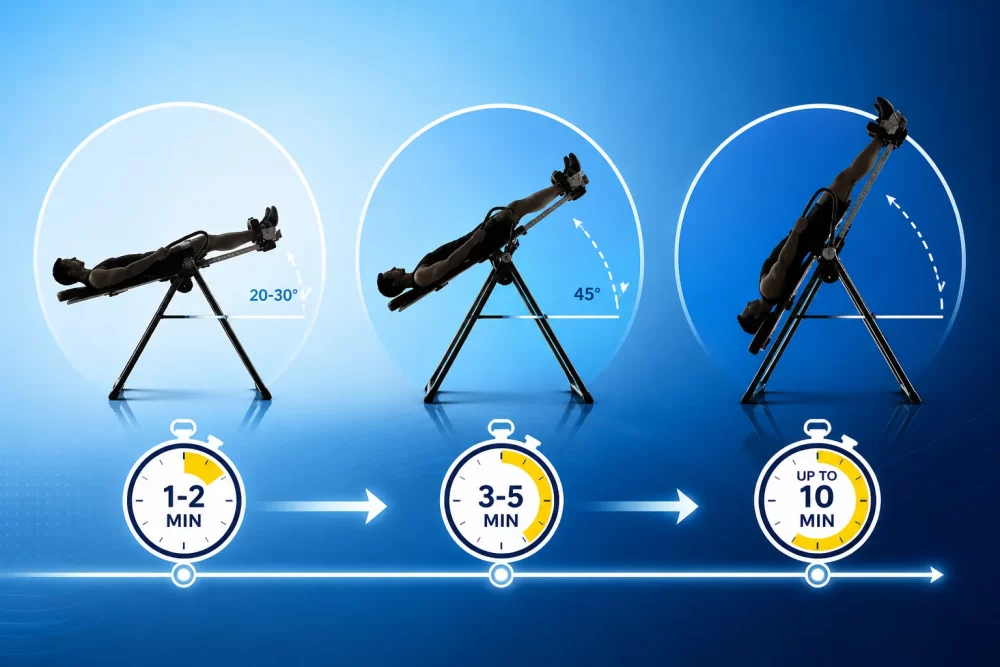
Beginners should start with 1-2 minutes per session on an inversion table at a shallow 20-30 degree angle, gradually building to 3-5 minutes as comfort increases. Most people achieve optimal spinal decompression and muscle relaxation within this 3-5 minute window, repeated 2-3 times daily. Duration matters less than consistency and proper angle progression—your body signals when muscles release and tension eases.
Key Takeaways
Start small: Begin with 1-2 minute sessions at 20-30 degrees for the first week
Build gradually: Progress to 3-5 minutes per session as your body adapts
Frequency wins: Multiple short sessions (2-3 daily) outperform single long sessions
Listen to your body: Stop immediately if you experience dizziness, pressure, or discomfort
Avoid extremes: Most benefits occur at 45-60 degrees; full inversion increases risks without added benefit
Cap your sessions: Even experienced users should limit sessions to 5-10 minutes maximum
Rest between rounds: Wait at least 90 seconds between sessions to prevent ankle fatigue
Timing matters: Morning sessions, post-workout recovery, and evening stress relief offer distinct benefits
Safety first: Never exceed your comfort level or ignore warning signs from your body
How Long Should Beginners Use an Inversion Table?
Beginners should limit their first sessions to 1-2 minutes at a 20-30 degree angle. Your body needs time to adapt to the reversed gravitational pull and increased blood flow to your head. Think of inversion therapy like building strength—you wouldn’t attempt a maximum deadlift on day one, and you shouldn’t rush into steep angles or long durations with inversion.
Start with these beginner guidelines:
Week 1: 1-2 minutes at 20-30 degrees, once daily
Week 2: 2-3 minutes at 30-40 degrees, once or twice daily
Week 3: 3-4 minutes at 40-45 degrees, 2-3 times daily
Week 4+: 3-5 minutes at 45-60 degrees, 2-3 times daily
Common beginner mistake: Rushing to full inversion because it “feels like it should work better.” Steep angles increase blood pressure in your head and strain ankle muscles without providing additional spinal decompression benefits. Choose moderate angles (45-60 degrees) for maximum benefit with minimum risk.
For those new to inversion therapy, our complete guide to using an inversion table safely covers proper setup and technique.
What Is the Optimal Duration for Experienced Users?
Experienced users typically invert for 3-5 minutes per session, 2-3 times daily. This duration allows muscles to fully relax and release tension while avoiding the fatigue and pressure buildup that occurs during longer sessions. Your muscles signal completion when you feel a noticeable release or “letting go” sensation in your spine.
The 4-5 method recommended by many chiropractors provides a practical framework:
4-5 minutes per session
45 degrees maximum angle (not full inversion)
4-5 times per week minimum
Most people achieve complete muscle relaxation within 3-5 minutes. Extending beyond this timeframe rarely provides additional benefits and increases risks like dizziness, excessive blood pressure elevation, and ankle discomfort.
Decision rule: If you don’t feel muscle release by the 5-minute mark, the issue likely requires a different angle or technique adjustment rather than more time inverted.
How Many Times Per Day Should You Use an Inversion Table?
Most people benefit from 2-3 short sessions daily rather than one extended session. This approach provides consistent spinal decompression throughout the day while minimizing cumulative stress on your cardiovascular system.
Ideal timing for multiple daily sessions:
Morning (5-10 minutes after waking): Rehydrates spinal discs compressed during sleep
Post-workout (within 30 minutes): Accelerates muscle recovery and reduces inflammation
Evening (1-2 hours before bed): Releases accumulated tension and promotes relaxation
Spacing matters: Allow at least 90 seconds between consecutive sessions to prevent ankle muscle fatigue. Your ankle muscles work hard to stabilize your inverted body, and inadequate rest increases fall risk.
For those managing specific conditions, understanding who should not use an inversion table helps determine appropriate frequency.
What Angle Should You Use and for How Long?
The angle you choose directly impacts how long you should remain inverted. Moderate angles (45-60 degrees) provide optimal spinal decompression with minimal cardiovascular stress, making them suitable for longer 3-5 minute sessions.
Angle-duration guidelines:
Angle RangeRecommended DurationBest For20-30°1-3 minutesBeginners, first week30-45°2-4 minutesBuilding tolerance, weeks 2-345-60°3-5 minutesOptimal therapeutic range60-90°1-2 minutes maxAdvanced users only, higher risk
Why 45 degrees works best: This angle creates sufficient spinal traction to decompress discs while keeping blood pressure elevation manageable. Full inversion (90 degrees) dramatically increases intraocular and blood pressure without providing proportionally greater spinal benefits.
Edge case: Athletes seeking maximum muscle recovery may benefit from brief 60-second sessions at steeper angles (60-75 degrees) immediately post-workout, but should return to moderate angles for longer decompression sessions.
How Do You Know When to Stop Your Inversion Session?
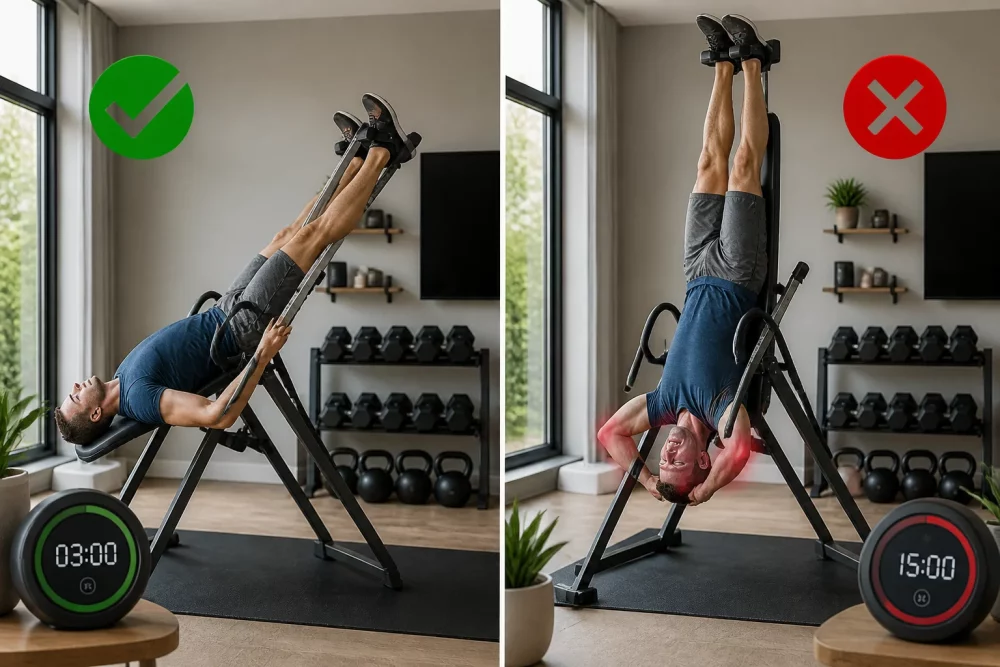
Your body provides clear signals when you’ve achieved optimal decompression. Stop your session when you feel muscles release, experience any discomfort, or reach the 5-minute mark—whichever comes first.
Physical signals to end your session:
Muscle release: Noticeable “letting go” sensation in your lower back
Warmth or tingling: Indicates increased blood flow and relaxation
Pressure in head: Sign you’ve reached your cardiovascular limit
Dizziness or disorientation: Immediate stop signal
Ankle discomfort: Your stabilizing muscles need rest
Never ignore these warning signs: Headache, sharp pain, vision changes, or nausea require immediate return to upright position and may indicate you should consult a healthcare provider before continuing inversion therapy.
The dangers of inversion tables become more likely when users ignore these body signals or exceed recommended durations.
Can You Use an Inversion Table Too Much?
Yes, excessive inversion creates unnecessary cardiovascular stress and can lead to chronic headaches, vision problems, and joint strain. Limit total daily inversion time to 15-20 minutes maximum, spread across multiple sessions.
Signs of overuse:
Persistent headaches after sessions
Increased eye pressure or vision changes
Ankle or knee joint pain
Dizziness that lasts beyond your session
Worsening back pain rather than improvement
Recovery principle: Your spine needs time between sessions to adapt to the decompression stimulus. Constant or excessive inversion prevents this adaptation and can actually increase inflammation.
Choose 3-5 minute sessions with adequate rest over marathon inversion sessions. Your inversion table results improve with consistency and moderation, not duration.
What’s the Best Progression Schedule for Increasing Duration?
A structured progression prevents injury and builds tolerance safely. Add 30-60 seconds to your session duration each week while simultaneously increasing angle by 5-10 degrees.
Sample 4-week progression:
Week 1:
Duration: 1-2 minutes
Angle: 20-30 degrees
Frequency: Once daily
Week 2:
Duration: 2-3 minutes
Angle: 30-40 degrees
Frequency: 1-2 times daily
Week 3:
Duration: 3-4 minutes
Angle: 40-50 degrees
Frequency: 2-3 times daily
Week 4:
Duration: 4-5 minutes
Angle: 45-60 degrees
Frequency: 2-3 times daily
Plateau principle: Once you reach 5 minutes at 45-60 degrees, maintain this level rather than continuing to increase. Additional duration or steeper angles provide diminishing returns with increasing risks.
Setback protocol: If you experience discomfort or miss several days, drop back one week in the progression rather than resuming where you left off.
How Does Your Condition Affect Inversion Duration?
Different conditions require different approaches to duration and frequency. Lower back pain typically responds to shorter, more frequent sessions, while muscle recovery benefits from slightly longer durations.
Condition-specific guidelines:
Lower back pain:
Start: 30-60 seconds at 20 degrees
Build to: 3 minutes at 45 degrees
Frequency: 3-4 times daily
Focus: Multiple short decompressions
Sciatica:
Start: 1-2 minutes at 30 degrees
Build to: 4-5 minutes at 45-60 degrees
Frequency: 2-3 times daily
Focus: Sustained decompression to reduce nerve pressure
Muscle recovery (athletes):
Duration: 3-5 minutes
Angle: 45-60 degrees
Frequency: Once post-workout, once evening
Focus: Lymphatic drainage and inflammation reduction
Stress relief:
Duration: 3-5 minutes
Angle: 30-45 degrees (gentler)
Frequency: Evening session
Focus: Relaxation over aggressive decompression
Understanding the benefits of inversion therapy for your specific condition helps optimize your duration strategy.
Conclusion
Duration matters less than consistency when using an inversion table. Start with 1-2 minutes at shallow angles, build gradually to 3-5 minutes at 45-60 degrees, and repeat 2-3 times daily for optimal results. Your body signals when muscles release—typically within 3-5 minutes—making longer sessions unnecessary and potentially risky.
Take action today:
Set a timer for your first 1-2 minute session at 20-30 degrees
Schedule sessions at consistent times (morning, post-workout, evening)
Track your progress weekly, adding 30-60 seconds as comfort allows
Listen to your body and stop at any warning signs
Maintain consistency rather than chasing longer durations
The right inversion table makes proper duration management easier. Explore our inversion table buying guide to find equipment with precise angle controls and built-in timers that support safe, effective sessions.
Remember: three 3-minute sessions beat one 10-minute session every time. Start conservative, progress gradually, and let muscle release—not the clock—determine your optimal duration.
Frequently Asked Questions
How long should a first-time user stay on an inversion table?
First-time users should limit sessions to 1-2 minutes at 20-30 degrees. This allows your body to adapt to reversed blood flow and gravitational changes without overwhelming your cardiovascular system or causing dizziness.
Is 10 minutes too long on an inversion table?
Yes, 10 continuous minutes exceeds recommended guidelines for most users. Sessions longer than 5 minutes increase cardiovascular stress and headache risk without providing additional spinal decompression benefits. Break longer durations into multiple 3-5 minute sessions instead.
How many times per day can you safely use an inversion table?
Most people safely use an inversion table 2-3 times daily with sessions spaced at least 2-3 hours apart. Total daily inversion time should not exceed 15-20 minutes across all sessions.
What happens if you stay inverted too long?
Excessive inversion duration causes blood pressure elevation in your head, increased intraocular pressure, potential vision problems, severe headaches, and ankle muscle fatigue that increases fall risk. Always limit sessions to 5 minutes maximum.
Should you invert every day?
Daily inversion is safe and beneficial for most people when following proper duration guidelines. Consistency matters more than intensity—daily 3-minute sessions provide better results than sporadic longer sessions. Take rest days if you experience any discomfort.
How long does it take to see results from inversion therapy?
Most people notice immediate temporary relief after their first session, but lasting improvements typically appear after 2-3 weeks of consistent daily use. Chronic conditions may require 4-6 weeks of regular sessions to show significant improvement.
Can you sleep on an inversion table?
Never sleep or lose consciousness while inverted. Prolonged inversion dramatically increases health risks, and you cannot monitor your body’s warning signals while asleep. Always set a timer and remain alert during sessions.
What angle provides the best results in the shortest time?
45-60 degrees provides optimal spinal decompression in 3-5 minutes. This moderate angle creates sufficient traction force while minimizing cardiovascular stress, making it the most efficient angle for therapeutic benefit.
Should you invert before or after exercise?
Both timing options offer benefits. Pre-exercise inversion (1-2 minutes) warms up spinal joints, while post-exercise sessions (3-5 minutes) accelerate recovery and reduce inflammation. Post-workout timing generally provides greater therapeutic value.
How long should seniors use an inversion table?
Seniors should start with 30-60 seconds at 20 degrees and progress more slowly than younger users, potentially taking 6-8 weeks to reach 3 minutes at 45 degrees. Always consult a healthcare provider before beginning inversion therapy after age 60.
Does body weight affect how long you should invert?
Body weight doesn’t directly affect optimal duration, but heavier individuals may experience faster ankle muscle fatigue. Focus on proper ankle support and take breaks if you notice discomfort before reaching your target duration.
Can you use an inversion table twice in a row?
Yes, but wait at least 90 seconds between consecutive sessions to allow ankle muscles to recover and blood pressure to normalize. Two 3-minute sessions with rest between them work better than one 6-minute session.