Nearly 70% of inversion table users report significant pain relief within their first month, yet most abandon the practice within six months when benefits mysteriously vanish. This phenomenon reveals a critical gap between marketing promises and physiological reality. The Inversion Table Paradox: Why Beginners See Results But Long-Term Users Often Plateau represents one of the most misunderstood aspects of spinal decompression therapy, leaving thousands of users frustrated and confused about why their initial success fades.
Key Takeaways
- Beginners experience rapid relief because inversion provides a novel decompression stimulus that temporarily reduces spinal pressure and inflammation
- Long-term users plateau when their bodies adapt to the same repetitive stimulus, diminishing the therapeutic response over time
- The plateau effect typically occurs between 3-6 months of consistent use, regardless of inversion angle or session duration
- Breaking through the plateau requires strategic protocol variations including angle cycling, duration adjustments, and complementary exercises
- Clinical evidence shows inversion therapy works best as part of a comprehensive treatment program rather than a standalone solution
Understanding the Initial Success Phase
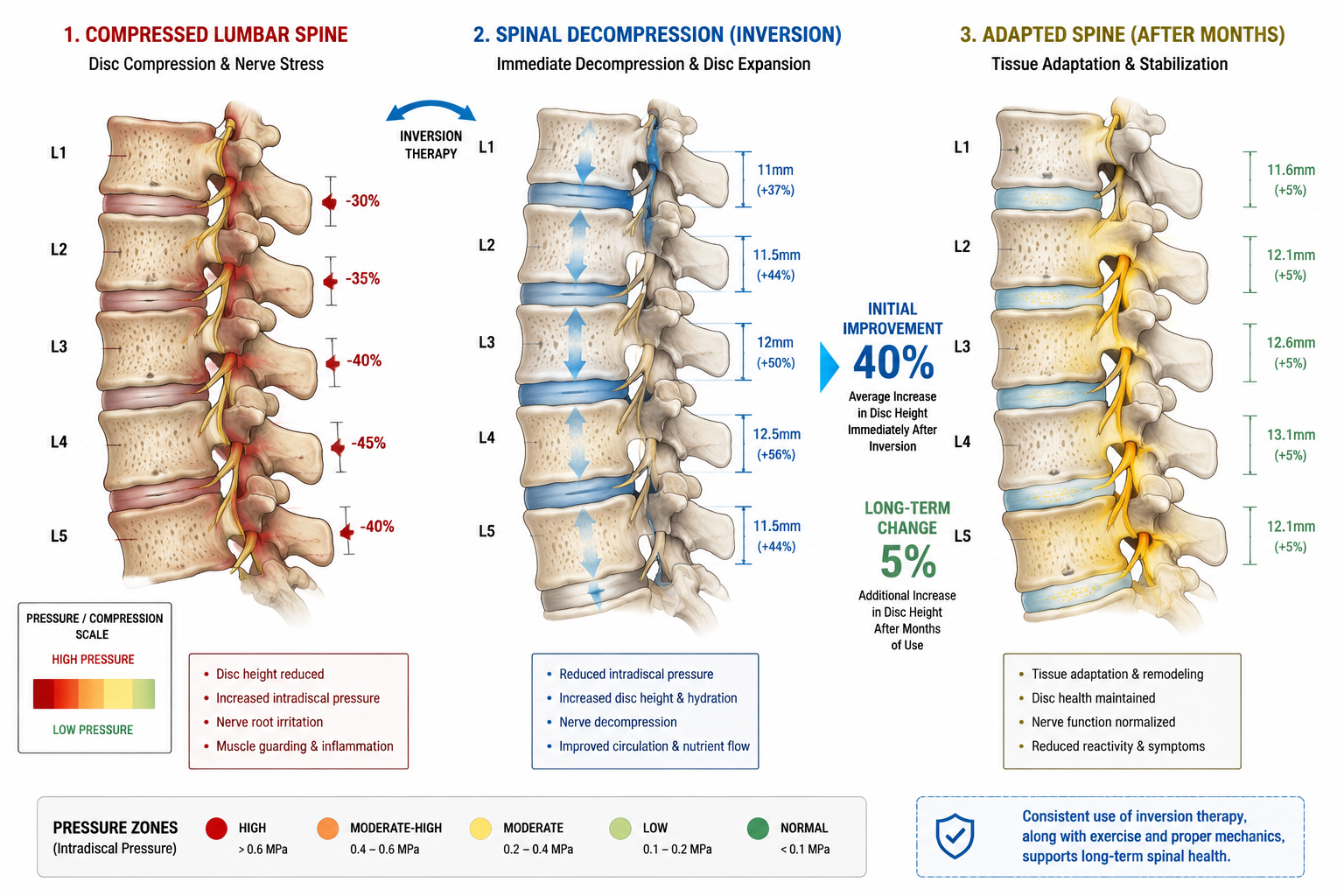
Think of your spine like a sponge compressed under a heavy weight—the moment you lift that weight, the sponge expands and absorbs fresh fluid. Inversion therapy creates this exact effect during the first weeks of use.
When beginners start inversion therapy for back pain, their bodies encounter a completely new mechanical stimulus. Gravity reverses its typical downward compression, allowing intervertebral discs to expand and rehydrate. This immediate decompression triggers several beneficial responses:
Acute inflammation reduction occurs as pressure releases from compressed nerve roots. Users with sciatica or herniated discs often experience dramatic relief within the first week because the mechanical irritation decreases substantially.
Increased disc spacing provides temporary relief from bone-on-bone contact in degenerative conditions. The inversion table results timeline shows most users notice improved mobility and reduced morning stiffness during this initial phase.
Enhanced circulation delivers fresh nutrients to spinal tissues while removing metabolic waste products. This flush effect contributes to the sensation of relief that beginners consistently report.
Cleveland Clinic research confirms that some users find short-term relief from compressed-disc pain, though the evidence remains mixed regarding long-term effectiveness. The key word here is “short-term”—a pattern that directly explains why beginners starting at 20% angles often experience such encouraging initial results.
The Inversion Table Paradox: Why Beginners See Results But Long-Term Users Often Plateau
The plateau phenomenon emerges from a fundamental principle of human physiology: therapeutic adaptation. Your body constantly adjusts to repeated stimuli, and inversion therapy proves no exception to this rule.
The Physiological Adaptation Mechanism
After 3-6 months of consistent inversion sessions, several adaptation processes diminish the initial benefits:
Tissue accommodation occurs as ligaments, muscles, and connective tissues adjust to the decompression stimulus. What once felt like significant relief becomes the new baseline, and your nervous system stops registering the same degree of change.
Neurological habituation reduces the pain-relief signal over time. Your brain essentially recalibrates its pain threshold, making the same inversion angle and duration less effective at triggering endorphin release and pain modulation.
Mechanical tolerance develops as your spinal structures adapt to the traction force. The Spine Center notes that most studies fail to show significant long-term benefit, and pain often returns once gravity resumes normal loading—a clear indication that the body adapts rather than permanently changes.
Why the Plateau Happens to Most Users
The inversion table plateau effect affects users regardless of equipment quality or initial success level. Three primary factors drive this universal experience:
Static protocol adherence keeps most users locked into the same routine. They invert at the same angle, for the same duration, at the same time of day. This predictability allows complete physiological adaptation.
Lack of progressive overload means the stimulus never increases. Unlike strength training where you add weight, most inversion users never modify their approach once they find a comfortable routine.
Absence of complementary interventions limits overall progress. WebMD research indicates inversion therapy probably does not work as an effective long-term treatment when used alone, suggesting the need for integrated approaches.
A PubMed Central study on lumbar disc disease showed that inversion therapy reduced symptoms and surgery rates in patients with specific conditions—but this favorable evidence applies to a narrow population and does not override the broader pattern of diminishing returns over time.
Breaking Through the Plateau: Evidence-Based Strategies
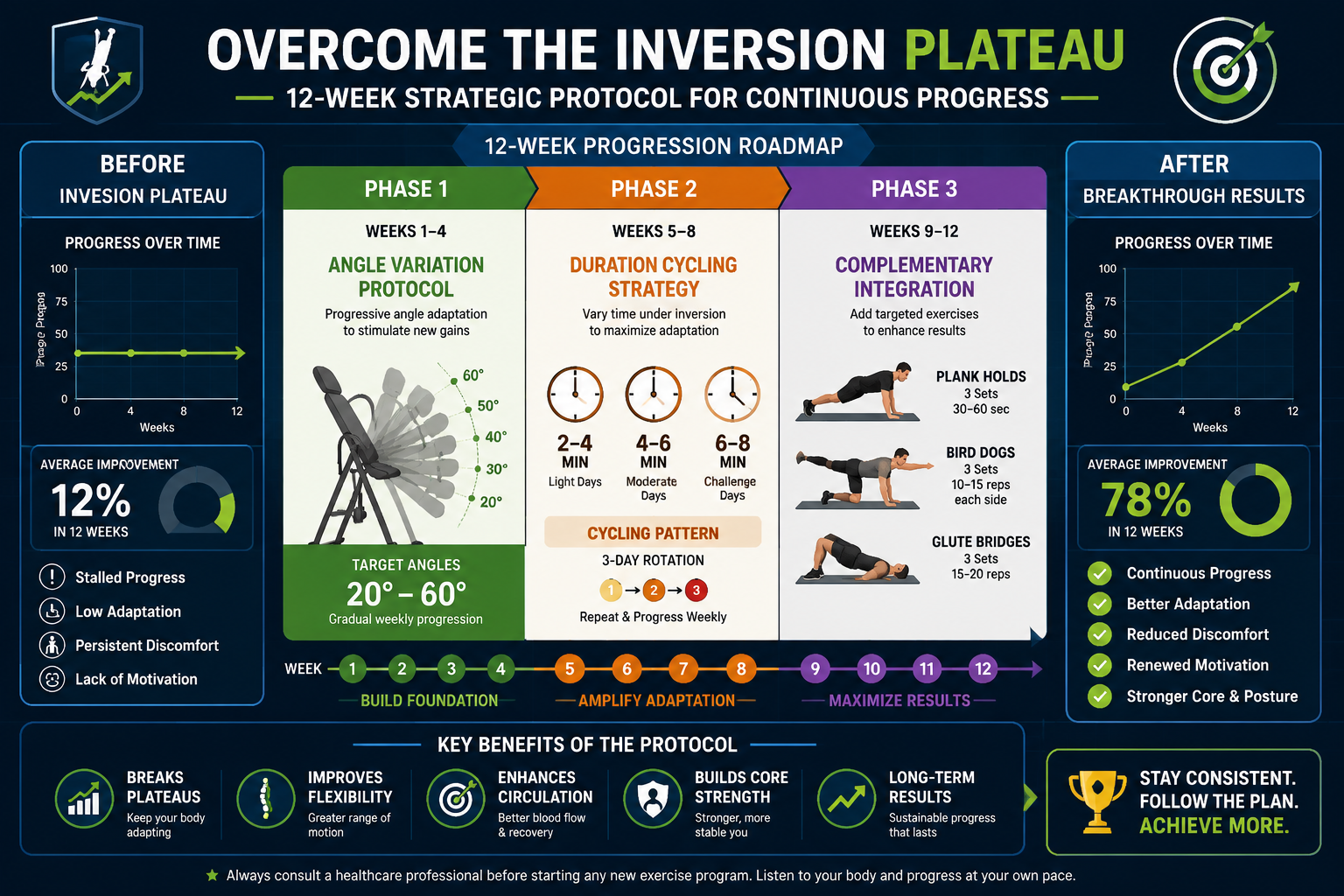
The Inversion Table Paradox: Why Beginners See Results But Long-Term Users Often Plateau does not mean inversion therapy becomes useless. It means users must evolve their approach to maintain benefits.
Angle Variation Protocol
Cycling through different inversion angles prevents complete adaptation:
- Week 1-2: 20-30 degrees for 3-5 minutes
- Week 3-4: 40-50 degrees for 5-7 minutes
- Week 5-6: 60+ degrees for 2-3 minutes
- Week 7-8: Return to 20-30 degrees
This cyclical approach keeps your nervous system responsive to the decompression stimulus. The variation prevents your body from fully adapting to any single position.
Duration and Frequency Adjustments
Strategic timing changes reintroduce novelty to your routine:
Interval inversion alternates between short, frequent sessions (2 minutes, three times daily) and longer, less frequent sessions (10 minutes, twice weekly). This unpredictability maintains therapeutic effectiveness.
Recovery periods allow your body to partially de-adapt. Taking a full week off every 6-8 weeks can restore sensitivity to the inversion stimulus. Medical News Today notes that safe duration guidelines recommend limiting sessions to prevent excessive adaptation.
Complementary Exercise Integration
Combining inversion with active rehabilitation produces superior long-term results:
Core strengthening exercises performed immediately after inversion sessions capitalize on the temporary decompression window. Your spine remains slightly elongated, making exercises more effective.
Dynamic stretching sequences between inversion intervals maintain tissue responsiveness. The combination creates a more comprehensive stimulus than inversion alone.
Postural correction work addresses the underlying mechanical issues that caused pain initially. Inversion provides temporary relief, but postural improvements create lasting change.
The American College of Physicians guidance emphasizes the lack of clinical evidence supporting inversion therapy as a standalone treatment for back pain, reinforcing the need for integrated approaches.
Safety Considerations for Long-Term Users
Extended inversion therapy use requires heightened safety awareness. Cleveland Clinic warns that inversion increases pressure in the skull and may cause serious harm, particularly with repeated use.
Cardiovascular monitoring becomes essential for long-term users. Blood pressure elevation during inversion can accumulate risk over months and years of practice.
Fall prevention protocols matter more as users age or increase inversion angles. A case-series paper on inversion-table injuries recommends limiting inversion to under 1 minute with recovery time of at least 1.5 minutes between trials.
Medical supervision ensures underlying conditions do not worsen. Users with chronic pain management needs should coordinate inversion therapy with their healthcare providers.
When to Modify or Discontinue Use
Recognizing when the plateau signals a need for change versus a need to stop entirely requires careful assessment:
Persistent pain increase after sessions indicates your body no longer responds positively. This differs from the plateau effect and suggests inversion may be contraindicated for your condition.
New symptoms such as increased headaches, vision changes, or dizziness warrant immediate discontinuation and medical evaluation. These signs indicate excessive pressure effects.
Zero benefit after protocol modifications suggests your pain source does not respond to mechanical decompression. Consider exploring alternative approaches for chronic pain beyond inversion therapy.
Conclusion
The Inversion Table Paradox: Why Beginners See Results But Long-Term Users Often Plateau stems from predictable physiological adaptation rather than equipment failure or user error. Beginners experience dramatic relief because inversion provides a novel decompression stimulus their bodies have never encountered. Long-term users plateau because their nervous systems, connective tissues, and spinal structures adapt to the repetitive stimulus, diminishing the therapeutic response.
Breaking through this plateau requires strategic intervention: cycle inversion angles every 2-4 weeks, vary session duration and frequency, integrate complementary core strengthening exercises, and take periodic recovery breaks to restore tissue sensitivity. Most importantly, recognize that inversion therapy works best as one component of a comprehensive back pain management program rather than a standalone solution.
Start by assessing your current inversion routine. If you have used the same angle and duration for more than three months, implement the angle variation protocol immediately. Track your pain levels weekly to identify whether modifications restore benefits. If you continue experiencing plateau effects despite protocol changes, consult with a physical therapist or spine specialist to develop an integrated treatment approach that addresses your specific condition.
The evidence remains clear: inversion therapy can provide meaningful relief, but only when users understand and actively manage the adaptation process that inevitably occurs with long-term use.
SEO Meta Title: Inversion Table Plateau: Why Long-Term Results Fade