Most back pain treatments undergo rigorous testing with hundreds or thousands of participants. Inversion therapy has been used for decades, yet the largest studies still involve fewer than 50 people. The research gap problem: why inversion table studies remain small and what that means for you reveals a troubling disconnect between widespread consumer use and scientific validation. This gap affects every purchasing decision and treatment expectation.
Think of inversion research like a bridge built with only a few support beams—it might hold some weight, but engineers cannot guarantee it will support everyone safely. The limited evidence base creates real uncertainty for anyone considering this therapy.
Key Takeaways
- Inversion table research consists primarily of small studies with fewer than 50 participants, making broad conclusions impossible
- Clinical guidelines classify the existing evidence as “methodologically weak” and insufficient for standard-care recommendations
- Safety concerns including cardiovascular risks and eye pressure increases limit researchers’ ability to conduct large-scale trials
- The strongest evidence supports inversion only as a complementary therapy for specific disc-related conditions, not general back pain
- Consumers must interpret marketing claims cautiously because the research does not support many popular assertions about long-term effectiveness
Why the Research Gap Problem Affects Inversion Table Evidence

The research gap problem: why inversion table studies remain small centers on three structural barriers that prevent large-scale investigation. First, funding agencies prioritize treatments with broader applications. Inversion therapy targets a narrow subset of back pain sufferers—primarily those with disc-related lumbar problems or sciatica—which limits its appeal to major research sponsors.
Second, study design challenges make inversion trials expensive and complex. Researchers cannot blind participants effectively because subjects know whether they hang upside down. Standardization proves difficult because studies use different table angles, session durations, and outcome measures. One investigation might test 60-degree inversion for two minutes, while another examines 20-degree angles for ten minutes. These variations prevent researchers from pooling results across studies.
Third, safety concerns create ethical barriers to large trials. Inversion increases intracranial pressure, raises cardiovascular demands, and elevates eye pressure. Clinical practice guidelines note that sudden pressure increases could prove fatal in vulnerable populations. Institutional review boards hesitate to approve large studies when existing evidence already documents risks for people with hypertension, glaucoma, heart disease, or stroke history.
The available research reflects these constraints. A comprehensive clinical practice guideline describes the inversion literature as a “small body of work” that remains “small and methodologically weak.” The most rigorous case-controlled study published in 2021 examined outcomes in a limited patient group and concluded that its findings make “a strong case” for a large prospective randomized controlled trial—not that inversion works definitively, but that larger trials remain necessary.
This evidence gap creates a paradox. Manufacturers market inversion tables widely, consumers purchase thousands of units annually, yet the scientific community cannot confirm whether the therapy delivers consistent, safe, long-term benefits. For individuals researching inversion therapy benefits, this uncertainty demands careful interpretation of both marketing materials and clinical claims.
What the Limited Research Actually Proves About Inversion Tables
The existing small studies reveal measurable physiological effects but mixed clinical outcomes. One physiological investigation documented that inversion increased trunk flexion, reduced paraspinal muscle activity, and created measurable distraction at the L4-5 and L5-S1 disc spaces. Importantly, this study found no changes in heart rate or blood pressure in the tested population—but the sample size limits generalization to broader groups.
Clinical outcomes show inconsistent patterns. The 2021 case-controlled study reported improvements in pain scores, disability measures, and reduced surgical need compared with control groups. However, reputable medical sources note that some studies demonstrate symptom relief while others show no benefit. Cleveland Clinic characterizes the current evidence as suggesting inversion may serve as a complementary therapy rather than a proven primary treatment.
The strongest positive signals emerge in narrow patient subgroups. Studies most frequently examine people with disc-related lumbar problems or sciatica, not general back-pain populations. This specificity matters because it means any documented benefit likely does not generalize to the millions of people experiencing back pain from other causes—muscle strain, arthritis, postural issues, or non-specific mechanical pain.
Safety data from real-world use adds concerning context. A case report series on inversion table fall injuries recommends limiting usage to under one minute with at least 1.5 minutes of recovery between sessions to reduce fall risk. Medical authorities consistently warn that inversion raises heart rate-related concerns, increases eye pressure, and poses risks for people with cardiovascular conditions, pregnancy, hiatal hernia, inner-ear problems, or certain joint diseases.
For consumers comparing models like the Innova ITX9900 vs. Teeter EP-560, these research limitations mean that product features matter more than clinical validation. No large study confirms that one table design delivers superior therapeutic outcomes over another.
How to Interpret Conflicting Findings and Make Informed Decisions
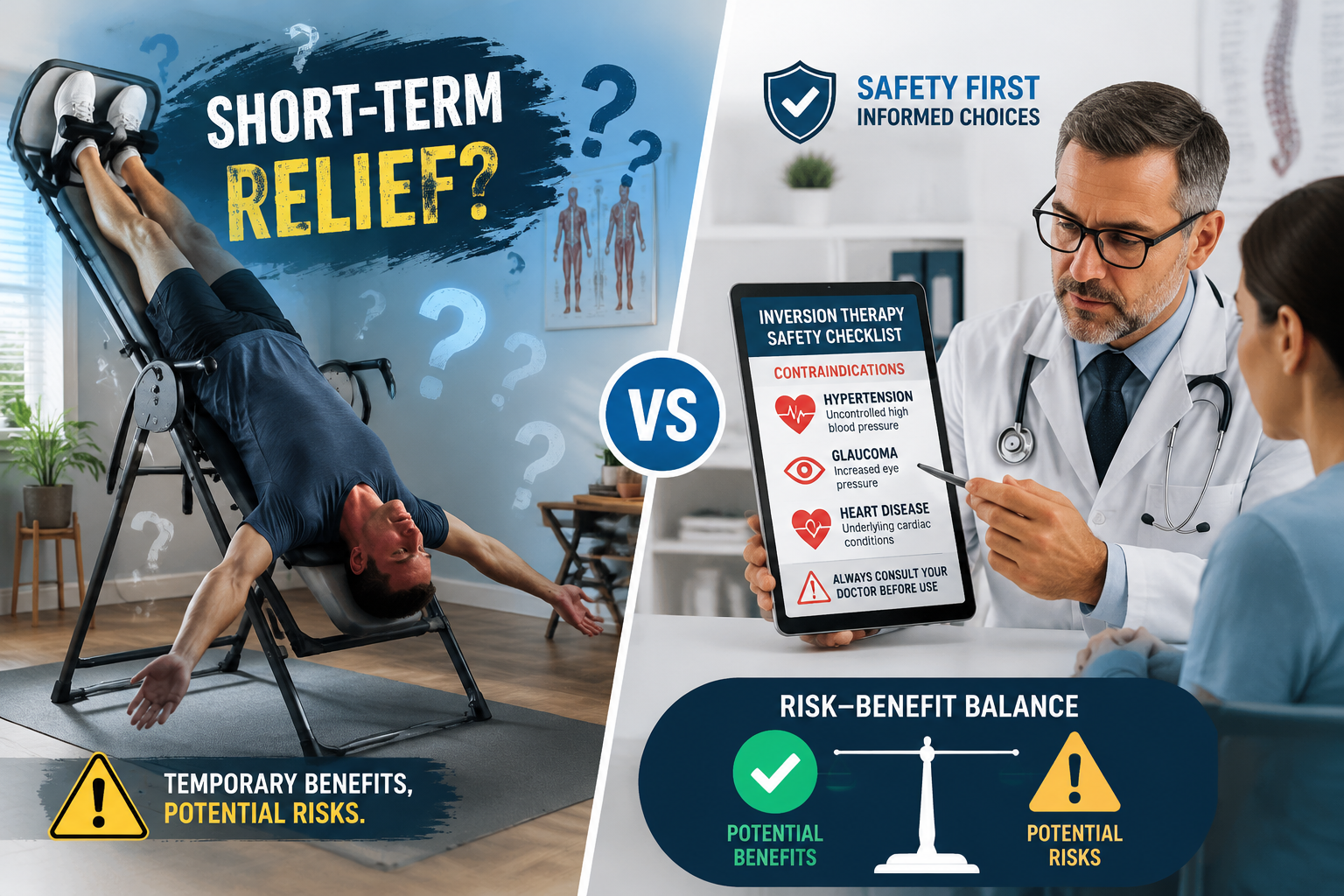
The research gap problem: why inversion table studies remain small creates practical challenges for anyone evaluating whether to try inversion therapy. Clinical guidelines still do not treat inversion as standard care because the literature remains insufficient to establish long-term safety and effectiveness. This explains why inversion rarely appears in mainstream back-pain treatment pathways alongside physical therapy, medication, or surgical options.
Consumers should apply three filters when evaluating inversion claims:
Filter 1: Distinguish between physiological effects and clinical benefits. Studies confirm that inversion creates spinal distraction and reduces muscle activity. These measurable changes do not automatically translate to pain relief, functional improvement, or long-term outcomes. Marketing materials often conflate mechanism with benefit.
Filter 2: Assess your specific condition against study populations. If you experience disc-related lumbar pain or sciatica, the limited evidence offers modest support for trying inversion as an adjunct therapy. If your back pain stems from other causes—arthritis, muscle strain, spinal stenosis—the research provides no validation. Understanding herniated disc treatment options helps clarify whether your condition matches studied populations.
Filter 3: Screen rigorously for contraindications. The safety concerns documented in small studies likely underestimate risks in broader populations. Anyone with cardiovascular disease, hypertension, glaucoma, stroke history, pregnancy, or balance disorders should avoid inversion or obtain explicit medical clearance. The dangers of inversion tables extend beyond the conditions studied in limited trials.
Practical decision framework: Treat inversion as an experimental adjunct, not a primary treatment. If you meet safety criteria and your condition matches studied populations, consider a trial period with conservative angles and short durations. Starting at 20% angles allows you to assess tolerance before progressing.
Monitor outcomes objectively. Track pain levels, functional capacity, and any adverse effects over 4-6 weeks. If you experience no improvement or encounter side effects, discontinue use. The research suggests that benefits, when they occur, manifest relatively quickly—prolonged use without results indicates non-response.
Recognize that results may plateau after 3-6 months. The limited long-term data means researchers cannot confirm whether inversion delivers sustained benefits beyond initial symptom reduction. Plan to reassess periodically rather than assuming indefinite effectiveness.
For individuals exploring inversion tables for scoliosis or other structural conditions, the evidence gap becomes even more pronounced. Studies focus primarily on disc-related pain, not spinal curvature or alignment issues. Claims about structural correction lack robust validation.
The research gap also affects product selection. Features like heat and massage functions add comfort but carry no clinical evidence of enhanced therapeutic value. Weight capacity, build quality, and safety features matter more than unproven add-ons when research cannot differentiate effectiveness between models.
Conclusion
The research gap problem: why inversion table studies remain small reflects structural barriers—limited funding, design challenges, and safety concerns—that prevent large-scale validation. The existing evidence confirms measurable physiological effects but provides only weak, inconsistent support for clinical benefits. Studies focus on narrow patient populations with disc-related conditions, leaving most back pain sufferers without relevant data.
For consumers, this gap demands cautious interpretation. Inversion may offer short-term symptom relief as a complementary therapy for specific conditions, but it lacks proof as a primary or long-term treatment. Screen rigorously for contraindications, start conservatively, and monitor outcomes objectively. Understand that marketing claims often exceed what limited research actually proves.
Take action: Consult a healthcare provider to determine whether your specific condition and health profile make you a candidate for inversion therapy. If you proceed, follow safe usage guidelines, begin with minimal angles, and track results systematically. Recognize that the absence of large studies means you participate in an evidence gap—your experience may differ significantly from limited trial outcomes. Make informed decisions by acknowledging both the potential benefits and the substantial unknowns that persist in inversion research.
SEO Meta Title: Research Gap: Why Inversion Table Studies Stay Small